Ekip
19 September 2015•Update: 19 September 2015
By Max Constant
BANGKOK
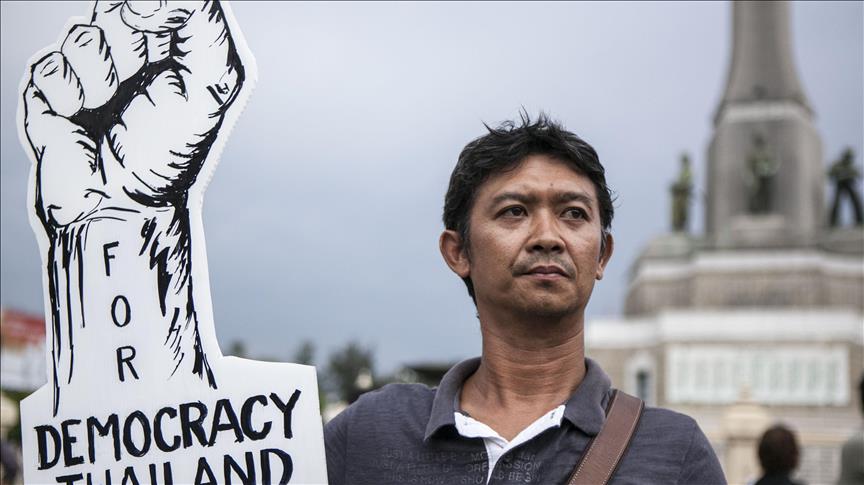
A rare small anti-coup demonstration was allowed to proceed under heavy police surveillance in military-ruled Thailand on Saturday, with hundreds of people protesting at a monument dedicated to democracy in Bangkok’s Old Quarter.
Around 100 activists walked from Thammasat University t0 the monument, where around 400 supporters awaited them on the anniversary of the 2006 military coup against establishment nemesis Thaksin Shinawatra that ushered in a long period of political instability.
More than a hundred police officers tried to block the demonstrators from entering the monument compound, but were overwhelmed, during the “Nine years under the military boots” event.
Some protesters carried posters showing people lifting a huge military boot or signs denouncing the 2006 military coup against establishment nemesis Thaksin Shinawatra.
Others alluded to the main slogan adopted by the junta since a coup last year -- “Return happiness to the people” – in shouting “We don’t want your happiness, we want power back” while lifting a banner with the same words.
The march had initially been allowed to proceed after lengthy negotiations between police and leaders of the New Democracy Movement -- a group of mostly students and academics opposed to the military regime – on the condition that signs bearing political slogans would not be raised.
Before the march, a seminar on the lessons of the 2006 coup had been held -- also after negotiations with police -- at Thammasat University with the participation of several academics and activists including political scientist Puanthong Pawakhapan and anti-military campaigner Sombat Boonngamanong.
During the debate, where plainclothes police officers and journalists outnumbered the participants, panelists were careful not to speak directly about the current political situation in Thailand, where the military again seized power last year.
The May 22, 2014 coup had overthrown the elected government of Yingluck Shinawatra, the younger sister of Thaksin, a deeply divisive figure who served as premier between 2001 and 2006.
Anti-junta activists consider the 2006 coup to mark the beginning of a fight by conservative elites -- backed by the military and bureaucracy -- to reverse Thailand’s political evolution and revert to a regime where appointed bureaucrats would dominate elected politicians.
Such a regime had existed between 1980 and 1988 under former Prime Minister Prem Tinsulanonda, who led the country despite never having been elected in a nationwide election.
Earlier this month, a military-appointed reform council rejected a draft constitution aimed at replacing the charter abolished after last year’s coup, extending the junta’s stay in power by around 20 months until elections are held in mid-2017 at earliest.
Junta leader-cum-Prime Minister Prayuth Chan-ocha has repeatedly insisted that he does wish to prolong his leadership.
He said earlier this month that he “did not want to stay one more day in power” if he could avoid it.
If, effectively, the junta holds power until mid-2017, it would be the longest military regime in Thailand’s history since the 1969 elections, which ended the 12-year dictatorship of Field Marshall Thanom Kittikachorn.