By Lauren Crothers
PHNOM PENH, Cambodia
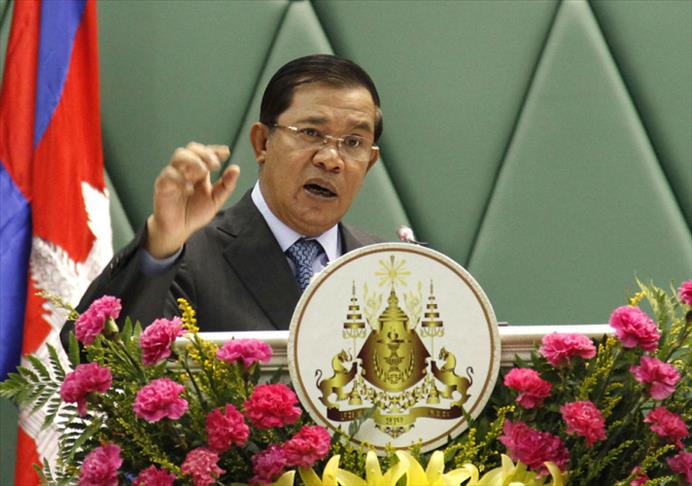
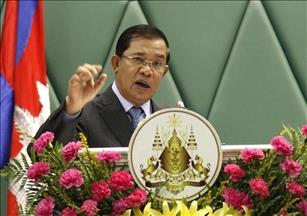
Last month Cambodian Prime Minister Hun Sen marked 30 years in office.
This week the veteran leader -- Asia’s longest serving political leader apart from Iran’s Ali Khamenei -- looked to strengthen his grip on the reins of power by seeking to secure his three sons’ political futures.
On Sunday, the ruling Cambodian People’s Party completed a three-day congress -- the first since the widely disputed 2013 election -- that saw 306 new faces join the 545-member central committee, the main decision-making body of the party.
Amid the recruits taking their places among the party elite were Hun Sen’s sons Manet, 37, Manith, 34, and 31-year-old Many.
The positioning of family members to ensure a smooth transition of power when a powerful patriarch finally steps down or dies is nothing unique to Cambodia.
However, political observers believe Hun Sen has been forced to move more carefully than some following the election 18 months ago, which saw the Cambodian People’s Party emerge victorious but significantly scathed.
The Cambodian People’s Party lost 22 seats in the 123-seat National Assembly to opponents. After the election, Hun Sen went to ground for a few weeks before he finally emerged looking grey and drawn at the opening of an overpass in Phnom Penh.
Ou Virak, the former president of the Cambodian Centre for Human Rights, said the shrewd Hun Sen has been making very deliberate manoeuvres to ensure control of the country remains firmly in the hands of his family.
"He’s treading the water carefully," Virak told the Anadolu Agency Tuesday. "He is looking at the moment for the handover to take place. I think he is very concerned.
"I’m looking at Hun Sen as a chess player. The chess player Hun Sen will not wait until he dies and leave it to fate. He will take a proactive move to ensure that the transitions will be there for his sons to take. That move will have to come while he still has power."
The party congress followed a highly critical Human Rights Watch report on the anniversary of the former Khmer Rouge commander’s third decade in power.
As well as the accession of the prime minister’s sons, the progeny of other leading party figures have also been helped up the political ladder as a way of injecting fresh blood into an organization long dominated by aging stalwarts.
For the 2013 election, Hun Many -- along with Sar Sokha, the son of Interior Minister Sar Kheng, and acting Senate President Say Chhum’s son Say Sam Al -- stood as candidates, though none was voted to the National Assembly.
After a reshuffle, however, older party lawmakers stood aside and the sons took their seats.
On Tuesday, the Cambodia Daily reported the installation of Sok Sokhan, the son of Deputy Prime Minister Sok An, to the assembly seat for the province of Takeo. He replaced the late telecommunications minister, So Khun, who died last month.
“I don't think he’s comfortable,” Virak said, referring to Hun Sen. "I think Hun Sen is in a compromise, allowing the sons of other people to climb the ranks. There needs to be balance."
Hun Sen’s sons hold some of the most crucial positions in the country.
Along with Hun Many the lawmaker, Hun Manith is a brigadier general who runs the military intelligence unit as a deputy chief.
Eldest son Hun Manet commands the counterterrorism unit at the Defense Ministry.
"Regardless of the qualifications of the sons, it’s still nepotism," Virak told AA.
"Even without powerful positions, connections to Hun Sen afford greater privileges. If you look at the way Hun Sen plays, he is looking at this move as a test and that is to have people in the right positions for the most important powerful position.
"Hun Manet is the most important -- he is the one we need to keep an eye on."
The West Point graduate is a lieutenant general in the Royal Cambodian Armed Forces. Last year, Hun Sen told an audience that Manet was born of a powerful spirit, revealed by a bright light from a Banyan tree at the moment of his birth.
The question remains whether 62-year-old Hun Sen will cling on to power or step aside but continue to pull the strings from behind the scenes.
Virak predicts the latter possibility as being the most likely.
He said that for Hun Sen, aged 32 when he became prime minister in 1985, to step down while still relatively young could be seen as running away.
Before the last election he pledged to remain in office until he was 74 but one obvious scenario that could see Hun Sen leave office voluntarily would be a bad performance at the general election in 2018.
According to independent political analyst Chea Vannath, Hun Sen is focusing not only on creating a smooth transition but on introducing serious reforms along the way.
She also cast doubt on the much-speculated possibility that there could be a power struggle between factions in the party when Hun Sen leaves.
“I think that the CPP is very smart,” Vannath told AA, referring to the party with its initials. "I heard speculation about CPP factions but that has never happened since the 1990s, for at least 20 years.
“I don’t think or see any tangible proof of evidence of factions. Rather, they would join forces to survive together and enjoy prosperity together rather than fighting with each other.”
As for Hun Sen, “he still has a lot of steam and whoever replaces him will still need him.”
One problem with the possible succession plan is that although Hun Sen’s sons may be well-connected, they still have to prove themselves and win hearts on their own merit.
“They have to work really hard to compete with the others in the current democratic system, even within their own party,” she said.