by M. Bilal Kenasari, Turgut Alp Boyraz
ANKARA
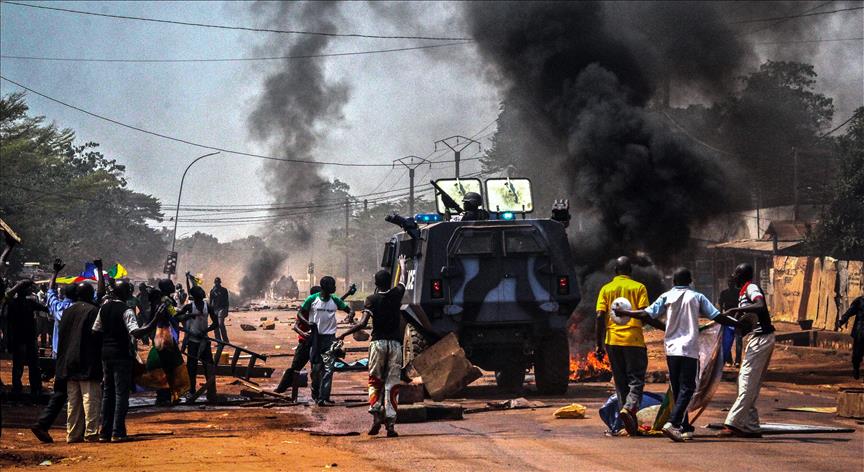
Almost a year since the coalition of rebel forces, known as Seleka, led a military coup in the Central African Republic, the country is now threatening to descend into sectarian violence.
CAR, which has seen clashes between militias, an international peacekeeping mission led by France, and the African Union, has a long history of abusive governments. However, Amnesty International's Joanne Mariner says the sectarian aspect is new.
"It has not seen sectarian violence nor has it seen extreme inter-ethnic violence; this is something new for CAR,” says Mariner.
The Senior Crisis Response Advisor for Amnesty said there has been an alarming escalation in sectarian violence, which NGOs warned on Tuesday, could lead to a catastrophic collapse of the local economy.
Mariner told AA that there has been a systematic looting of Muslims shops in the last month, which has forced many Muslims to flee their homes.
"Most of them lost their entire life savings. They lost everything and are leaving the country with very little,” says Mariner. “People are leaving in overloaded trucks and are going to Chad and Cameroon.”
One of those fleeing to Chad was pulled from a truck and lynched by a Christian mob, according to Human Rights Watch (HRW).
"[Soldiers] set his body on fire, while everybody around was laughing and taking photos with their mobile phones," said HRW's Emergencies Director Peter Bouckaert.
UNHCR spokesman, Babor Baloch, says that violence against civilians in the CAR, is affecting all religious communities, not only Muslims.
“There is a lot of violence against civilians, which affects all religions, all people who are there.”
The Seleka rebels, a broad coalition of anti-government groups, ousted President Francois Bozize in March 2013 and in the resulting power vacuum many of the rebels were allegedly involved in burning villages, killing and looting.
In response, groups known as the anti-balaka (anti-machete) were set up, initially to defend Christian communities from the Seleka rebels. Many of the Seleka, including the leadership, were Muslims and from the country's northeast - an isolated region which has historically been marginalized by the state.
The majority of the Seleka leadership have since fled the country; Seleka President Michel Djotodia was exiled to Benin after the international community pushed him out of power on January 10, 2014.
Though the Seleka has many Christian members, Mariner says that because many of the initial rebels were Muslims, the Christian populations began to turn against CAR's Muslims as a whole, without making any distinctions between rebels and civilians.
“In December people were already saying that all Muslims had to leave the country. They were also kicking out the Muslim foreigners, even though they had been there for decades, if not centuries,” claims Mariner.
“Anti-balaka control entire neighborhoods [in Bangui], they are armed and have checkpoints, which makes it difficult for minority Muslim groups to leave the country.”
Baloch highlighted the growing refugee situation: “The numbers are on the rise in-terms of people seeking a place in neighboring countries. But also the internal displacement picture is getting more complex day-by-day.”
UNHCR said that there are currently 838,000 internally displaced people in the CAR.
UNHCR does not have a breakdown of refugee numbers, in-terms of religious orientation of people (fleeing CAR), but Baloch said that out of the 9000 refugees that entered Cameroon in the last 10 days, 5000 came from the CAR.
The UN estimates that thousands of people in the CAR have been killed and 2.2 million are in need of humanitarian aid.
The land-locked Central African Republic is one of the poorest countries in Africa, with no border to sea, and has a population of 4.5 million: 50 percent Christian and 15 percent Muslim.
englishnews@aa.com.tr