French PM's government survives no-confidence vote
The no-confidence motion was submitted by the opposition after Valls bypassed parliament Tuesday to pass controversial economic reform package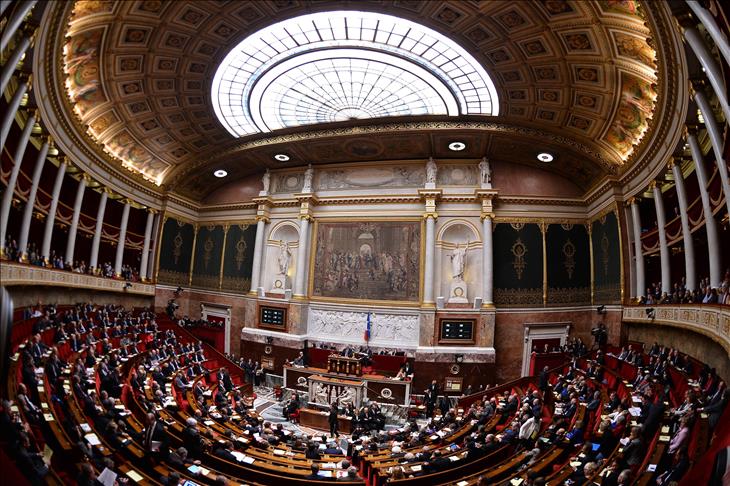
PARIS
French Prime Minister Manuel Valls's government has survived on Thursday a vote of no-confidence over a controversial economic reform law.
Only 234 voted for the no-confidence motion, which was submitted by opposition groups, led by the rightwing Union for a Popular Majority (UMP), party of former president Nicolas Sarkozy. The motion needed 289 voice to pass.
The French government on Tuesday used special decree powers to pass a controversial economic reform package.
Fearing that the bill would not be approved, French President Francois Hollande and Prime Minister Manuel Valls decided to bypass parliament on Tuesday using a French Constitution Article 49-3, which permits the government to pass legislation without submitting it to a vote in parliament. However, it does open the government to a no-confidence challenge.
Addressing the Valls during the discussion of the motion, the president of the UMP group in parliament, Christian Jacob, said: "The 49-3 article is the weapon used by the weak. And you are weak because your government's record is catastrophic."
"Your obsession is not to reform, your obsession is to last to build your personal image," he added.
Valls responded that the use of "the 49-3, is an act of authority facing the irresponsibility of some...My responsibility is to reform France."
The reform package proposed by Economy Minister Emmanuel Macron is a potpourri of measures, whıch touches on politically sensitive areas of the economy, and has irritated even among the ruling Socıalist party's ranks.
The most controversial was the partial liberalizing of work on Sunday, but lawyers and other professionals also objected strongly to opening access to professions like that of the notary, the public auctioneer and the bailiff.
Valls defended the reform bill saying "it will stimulate growth by facilitating corporate financing and by blasting the locks that hold back our economy."
"This law does not prohibit anything, it merely permits," he continued.
As the no-confidence vote is rejected, the economic reform package is considered as adopted. The bill will be presented to the Senate in the month of April.
According to a poll by Paris-based Odoxa-FTI Consulting sponsored by the economics newspaper Les Echos and Radio Classique released at the end of January, 61 percent of French voters support the bill.