By Benjamin Garvey
HONG KONG
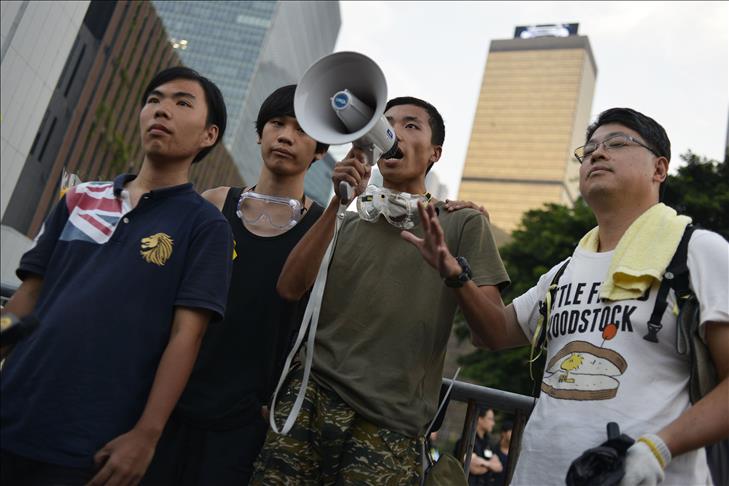
As demonstrations in Hong Kong entered their second week, a politician supportive of the occupy protesters said the civil disobedience movement could escalate if talks between the government and the Federation of Students failed to begin.
Emily Lau, chairperson of the Democratic Party, added that the protests could intensify if talks broke down after they started.
Protesting students have said there would be no formal dialogue as the government had not agreed to discuss political reform.
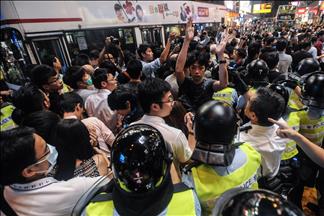
The development came as the protests entered their second week and demonstrators at the two main protest sites - Admiralty and Mong Kok - numbered in their hundreds.
The protesters are defying government orders to disperse as civil servants and students returned to their places of work and education.
Tourists mingled with the protesters Monday afternoon at the Mong Kok protest site.
"It's interesting. It's quiet and not out of hand," said an American tourist. "I was hesitant to come down at first because of what I had seen on the news."
Those observing the protesters included many from mainland China.
"It's all about power," said a 30-year-old woman from Shanghai when asked what she thought of the demonstration. "I don't want to take any side. We [mainland Chinese] envy Hong Kong people's freedoms. They have the right to express their opinions."

The city's leader, Chief Executive Leung Chun-ying, had said he would "take all necessary actions to restore social order" at the two major protest sites by Monday morning.
While the government had expressed Sunday that it was seeking talks with student protest leaders, preliminary discussions in preparation for meetings with Chief Secretary Carrie Lam Cheng Yuet-ngor began with little headway amid the lack of agreement on guidelines the next day.
Federation of Students leader Alex Chow Yong-kang said protestors’ doubts would be raised in the case of failure to hold talks on Tuesday, according to the South China Morning Post, and added, “We are all waiting and watching how the government acts, to see if this is their tactic to draw this out or whether they are willing to actually hold dialogue."
The Post also quoted Jasper Tsang Yok-Sing, Legislative Council chairman, as saying, “I hope the situation will continue to mellow out, but I understand that protesters have their reasons for staying...I just hope they will leave room for manoeuvre."
He expressed his uncertainty on whether the Legislative Council can meet Wednesday since "the safety of staff and lawmakers need to be ensured first."
While scuffles between protesters and opponents - whom some saw as agitators working on behalf of Beijing – had broken out frequently Sunday morning, a positive atmosphere with fewer scuffles prevailed as the day wore on with rising numbers of protesters and their supporters.
Tens of thousands have been gathering at the protest sites to push Beijing to loosen its controls over the former British colony.
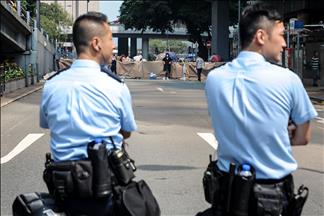
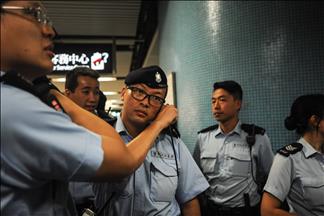
Police have fired tear gas and used pepper spray to clear protest sites, while a notorious faction of Hong Kong gangsters - triads - has been accused of attacking protests and sowing disharmony on behalf of Beijing.
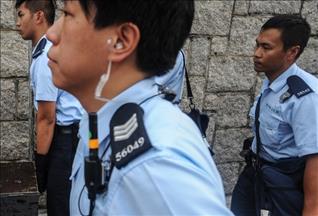
Police were accused of standing by and doing little to stop the attacks, in some cases arresting then quickly releasing instigators who soon renewed their assaults.
Since the pepper spray attacks, the movement has been dubbed the “umbrella revolution” because protesters have en-masse used umbrellas to shield themselves.
In August, Chinese leaders ruled that while Hong Kongers could choose their next chief executive in the 2017 elections, the candidates would have to be approved by Beijing first.
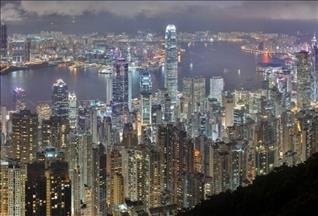
Hong Kong -- an international financial center -- was a British colony from 1842 to 1997.
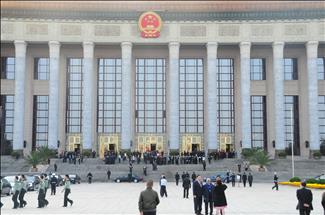
Last Monday, a spokesman for China's Foreign Ministry, Hua Chunying, said: "Hong Kong is China’sHong Kong. Hong Kong is purely our internal affair."
The non-violent movement is seen as the biggest challenge to Chinese rule in the territory since Beijing resumed sovereignty in 1997.
Some observers worry that if the protests persist andHong Kong police again fail to disperse the demonstrators, the Chinese military -- known as the People’s Liberation Army -- could be ordered to intervene.
That scenario revives memories of the killing of student protesters in Tiananmen Square, in the heart of Beijing, in June 1989. The 1989 movement, initiated by students to push for a democratic China, ended when the military shot dead hundreds of people, perhaps more than 1,000.

contact_the_ombudsman
is_there_an_error_in_this_story