By Turgut Alp Boyraz
JERUSALEM
The Israeli Foreign Ministry has tried to distance itself from threats made by its top diplomat to "behead" perceived disloyal Israeli Arabs, with its spokesman describing the remarks as "valid" but having "nothing to do" with Israeli "diplomacy."
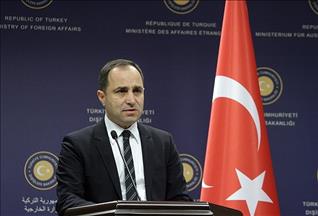
"Those words [by the FM] have nothing to do with our diplomacy," spokesman for the Israeli Foreign Ministry Emmanuel Nahshon told The Anadolu Agency in an interview in West Jerusalem.
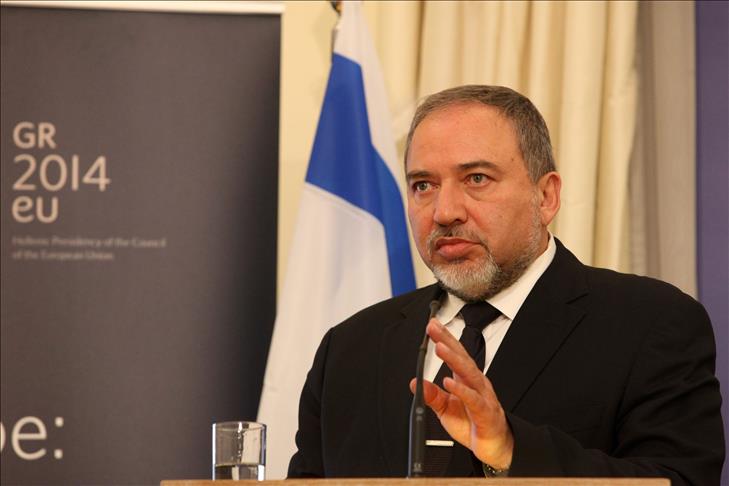
On Sunday, Israeli Foreign Minister Avigdor Lieberman, who is also the leader of the right-wing Yisrael Beiteinu Party, said Israeli-Arab citizens opposed to Israel should have their heads cut off with an axe.
"Whoever is with us should get everything; but whoever is against us… We have to lift up an axe and remove his head, otherwise we won't survive here," Lieberman said at a campaign rally, days before scheduled polls on March 17.
Lieberman also said that anyone who raised the black flag associated with "Nakba Day" – intended to symbolize mourning for Israel's establishment in 1948 – did "not belong" in Israel.
The remarks sparked uproar within the Arab community inside the self-proclaimed Jewish state as well in the Palestinian territories.
But Nahshon told AA that the remarks should not be taken out of context as a part of an "electoral campaign."
"It has nothing to do with the diplomacy and the Foreign Ministry. Those words are part of an election campaign. The argument he was making has nothing to do with Israeli foreign policy. It is simply another issue all together," Nahshon said.
"Lieberman is [Israel's] foreign minister and also head of a political party. He is running for elections and he wanted to make a political point," the spokesman added.
But despite admitting that Lieberman's remarks might be "a bit harsh," Nahshon insisted that he was making "a valid political point."
"Israeli Arabs who enjoy all the rights and benefits as Israeli citizens, but at the same time work very actively in order to destroy the state of Israel... cannot be acceptable to anyone," he explained.
"He [Lieberman] was saying that you cannot live in a country enjoying all the benefit of it and at the same time try to destroy it," Nahshon added.
The spokesman asserted that Lieberman tends to use "colorful rhetoric" and it was his "right" as a politician to do so.
"But I can promise you that the Israeli Foreign Ministry is not currently buying axes in order to behead people," he said.
Challenges
Nahshon believes that whoever emerges as the next Israeli prime minister will face Israel's relations with the Palestinian Authority as the main challenge to his government.
"There are a lot of unknowns. We don't know yet what step the Palestinian Authority will take after the Israeli elections," Nahshon said.
Ties between the Palestinian Authority and Israel have severely deteriorated since April, when peace talks collapsed over Israel's refusal to release a group of Palestinian prisoners despite earlier pledges to do so.
Last December, the Israeli government began withholding millions of dollars of Palestinian tax revenue, which it collects on behalf of the PA.
The move came shortly after Abbas applied for Palestinian membership in the International Criminal Court and a handful of other international treaties.
Earlier this month, the Palestine Liberation Organization (PLO)'s Central Committee decided to suspend security coordination with Israel.
Meanwhile, Israeli settlement building in East Jerusalem and the West Bank swung into full gear recently after peace talks broke down.
Palestinian negotiators insist that Israeli settlement building on Arab land must stop before any comprehensive peace agreement can be reached.
Yet, Nahshon said, the question would depend on "many things which are totally unknown at the moment," especially the question of which coalition would form the upcoming government.
"The political system in Israel is a system of coalitions. Even if one party emerges as the victor of the parliamentary elections, it depends very much on which other political parties will associate with it," he said.
"This will also determine the line regarding the settlement issue," he added.
Since it occupied the West Bank and East Jerusalem in 1967, Israel has continued to misappropriate Palestinian land – on which it continues to build Jewish-only settlements – in breach of international law.
The number of Israeli settlers living in settlements across the West Bank and East Jerusalem is estimated to be over 500,000.
Restoring relations with Israel's closest ally, the United States, is also a challenge that is expected to face the upcoming government.
Israeli Prime Minister Benjamin Netanyahu has repeatedly criticized the Obama administrations' efforts to reach a nuclear deal with Iran.
Earlier this month, Netanyahu addressed the U.S. Congress, saying: "Iran has proven time and again that it cannot be trusted."
Republican Speaker of the House of Representatives John Boehner had invited Netanyahu, much to the dismay of the U.S. administration.
"It is not a secret that there are difficulties between the Obama administration and PM Netanyahu. But it does not mean there is a huge problem between Israel and the U.S." Nahshon said.
"I think that is a problem which is relatively limited. Of course, it has an effect on some issues, but for instance it does not affect our security cooperation, economic exchange, tourism, and many other issues which are absolutely essential," he added.
Despite the negative impact the speech had on U.S.-Israeli relations, Nahshon argued that it was the right decision to speak before the U.S. Congress, but said it was too early to judge its effects on the negotiations between Iran and P5+1 countries.
"It is a bit early to see if Netanyahu's speech had any effect on the negotiations," he said.
Regarding recent tension between the U.S. administration and the Israeli government, Nahshon believes it was necessary to shed light on the danger posed by a deal that would allow Iran to get nuclear power.
Israel still believes that a combination of economic sanctions and diplomatic negotiations can bring a "good result," the spokesman said.
"This is why the speech of Netanyahu was so important, because it was pushing in the direction of a good agreement," he added.