SAO PAULO
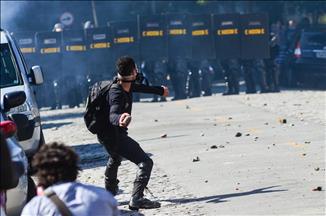
A day of rallies was held across Brazil on Friday in defense of scandal-hit oil giant Petrobras, workers' rights and in support of embattled President Dilma Rousseff.
The demonstrations were called by unions and social movements in 23 of 26 states and the Federal District, and also demanded political and agrarian reforms.
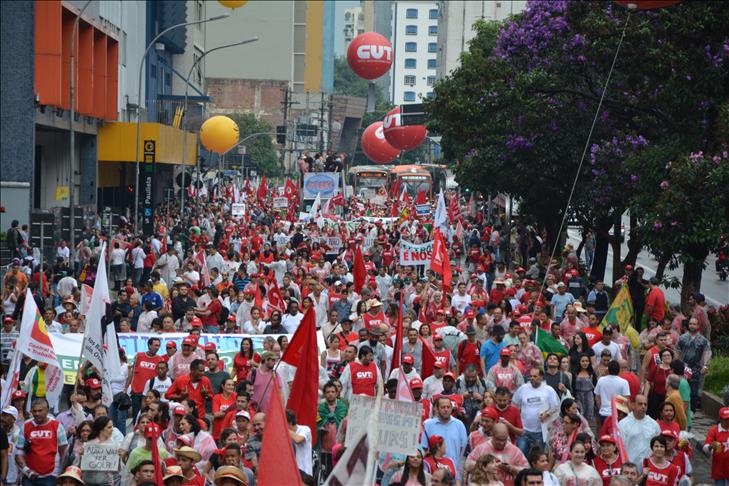
A rally in São Paulo gathered 100,000 demonstrators, according to one of its central organizers, the Unified Workers' Central (CUT) -- Brazil's main national workers' union group. Police put the number at around 12,000 at the end of the event.
Events in other states pushed the nationwide total to 148,000, according to organizers while police figures were far lower.
An Anadolu Agency correspondent at the country's biggest protest in São Paulo, which began at the Petrobras headquarters on Avenida Paulista, said many participants held banners and stickers with slogans defending Rousseff and urging state-controlled Petrobras, Brazil's biggest company, remain a fully public that serves Brazilians.
The event was peaceful, and a raft of political parties were represented, including Rousseff's Workers' Party.
While critical of the government, Friday's rallies in defense of Rousseff were seen as a direct response to nationwide protests scheduled for Sunday against the ruling parties and to call for Rousseff's impeachment. Organizers are expecting a huge turnout, particularly in São Paulo.
Vice President Michel Temer on Friday labeled the demand for the president to be impeached as "impossible and unthinkable" and most experts say there is no legal basis for impeachment, as the president has not been found guilty of a crime.
Although opposition parties are broadly backing Sunday's anti-government rallies, they have distanced themselves from calls for impeachment.
CUT President Vagner Freitas, speaking to reporters at the event in São Paulo, criticized those who continue to query October's general election result. "Protesting is a part of a democracy, but we cannot live in this climate of 'electoral limbo' for the rest of our lives," Freitas said.
Maria Izabel Azevedo Noronha, president of the APEOEPS teachers' union said, "If [Sunday's protest] were simply a criticism of the government, I would not be against it. But it's an event of those backing a coup," the G1 news portal quoted her as saying.
"If people want change, they have to urge alterations to economic policy and other aspects of the administration."
Rousseff's administration, formed of a fickle multi-party coalition, has been plagued with internal rebellions, but a decision by the Supreme Court last week to investigate senior political figures -- including congressional leaders and a former president, for allegations of involvement in a vast kickback scheme at Petrobras -- have also taken their toll politically and economically.
Uncertainty about whether the government will be able to politically push forward with fiscal policy aimed at kickstarting the country's economy, which is predicted to contract by more than 0.6 percent this year and see inflation near 8 percent, has continued to spook the markets, with Brazil's currency, the real, weakening significantly against a strong U.S. dollar.
The prospect of mass protests returning to Brazil's streets has also put pressure on the currency. The dollar was quoted at 3.24 reais at 5 p.m in São Paulo (GMT2000), the dollar's highest rate against the real since April 2003 and 6 percent higher than at the start of the week.