BANGKOK
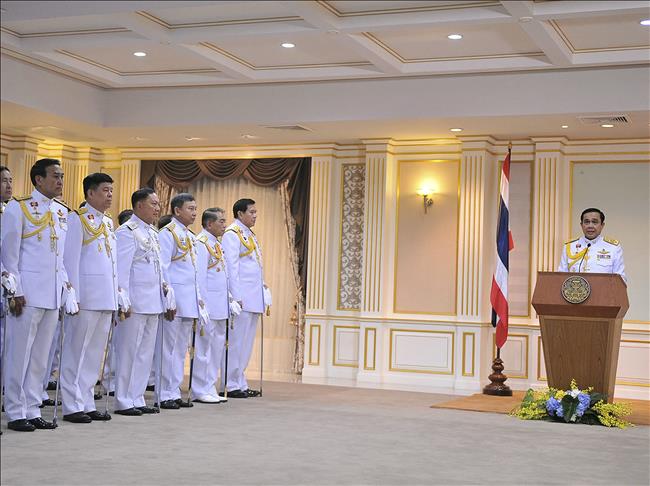
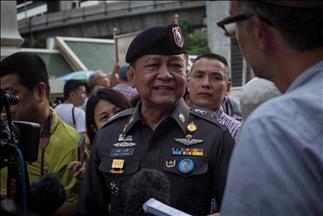
Thai junta leader General Prayuth Chan-ocha was officially been appointed prime minister by royal command Monday, cumulating the positions of interim government head, junta chief and army chief amid signs of a further hardening of the military regime that seized power May 22.
“I am ready to get tired,” a stern-faced Chan-ocha said after a brief ceremony during which he received the royal command issued by 86-year-old King Bhumibol Adulyadej.
The new prime minister, who had been elected through a quasi-unanimous vote of the junta-appointed National Legislative Assembly last Thursday, was then congratulated by military chiefs.
Analysts have expressed concerns that the concentration of power in the hands of a single military man is a worrying sign for the country’s future.
“It is a recipe for potential disaster. The difficulties will start now. It will not be a smooth ride,” Thitinan Pongsudhirak, a political scientist at Bangkok’s Chulalongkorn University, told the Anadolu Agency on Monday.
During his teleivised address last Friday, General Chan-ocha sounded more abrasive than usual.
“Some people don’t quite grasp the situation. I asked them not to oppose us. We don’t want to use violence against them,” he said in reference to critics of the junta.
The country has been under martial law since May 20.
Reacting to Chan-ocha’s statements in an editorial Monday, the Bangkok Post wrote that the general “must not expect that every order will be carried out instantly by every Thai.”
“The country at large is not going to give Gen. Prayuth the ‘Yes, Sir’ response he gets from army subordinates,” the newspaper said.
Chan-ocha is the first coup maker to become prime minister since Field Marshal Sarit Thanarat in 1957. After the previous coup in September 2006, a retired army officer appointed prime minister by the junta had proven difficult to control. Seeming to have drawn a lesson from this experience, Chan-ocha appears unwilling to take the risk of a government with some leeway altering his agenda.
Since the May 22 coup, Chan-ocha has grown increasingly at ease in his position as the country’s leader. In his weekly address each Friday, he confidently speaks at length about the junta's achievements in various sectors, such as the economy and control of mafia gangs.
Surveys typically indicate his high level of popularity – albeit, it is difficult to judge given that all criticisms of the junta are banned by martial law.
Despite this, criticisms are mounting on multiple fronts. Most notably, Chan-ocha is accused of reversing a decades-old policy of decentralization and cutting subsidies to assist farmers, as well as of a lack of transparency.
With the government's composition expected to be announced in coming days alongside King Bhumibol Adulyadej's approval of Chan-ocha's appointment, local media have already suggested that at least a third of ministers will be military officers. The interim government will lead the country until the new election is held toward the end of 2015.
The junta has promised "fully democratic elections" in October 2015 after the endorsement of a permanent constitution - which will not be submitted to a popular referendum.
Thailand's political crisis began in November when then Prime Minister Yingluck Shinawatra faced a wave of opposition protests after her government pushed through an amnesty that would have lifted the 2008 corruption conviction against her brother Thaksin, a divisive figure and ex-premier deposed in the 2006 coup.
Confronted by massive demonstrations, the government withdrew the bill, but the opposition alleged corruption by the government and Shinawatra family.
Yingluck dissolved the parliament December 9 and called February 2 elections, which were disrupted by the People Democratic Reform Committee, who want an unelected "people's council" to run Thailand until the political system is reformed.
She was then herself removed by the Constitutional Court on May 7 in relation to the transfer of a high-ranking civil servant in 2011. The May 22 coup removed the remaining ministers and dissolved the Senate, the only standing legislative assembly.
www.aa.com.tr/en/world