Anadolu Ajansı © 2026


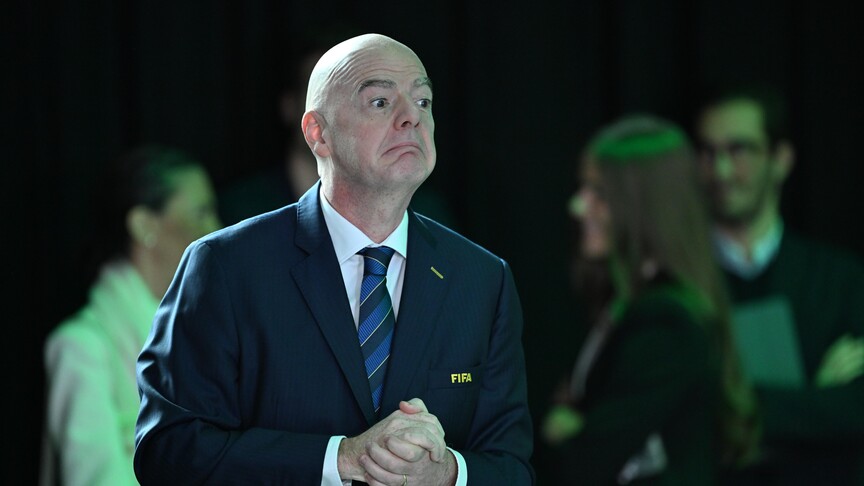
FIFA President Gianni Infantino could face two challengers in his bid for a fourth term after world football's governing body confirmed Thursday that it had received three nominations for its March 2027 presidential election.
French Football Federation President Philippe Diallo and Japan Football Association honorary president Kohzo Tashima are seeking to challenge Infantino, whose leadership has faced criticism over governance, presidential term limits and a withdrawn proposal to bring private investors into FIFA's commercial operations.
The election will take place on March 18, 2027, at the 77th FIFA Congress in Rabat, Morocco, where FIFA's 211 member associations are entitled to vote.
Infantino, who has led FIFA since February 2016, is seeking to remain in office until 2031.
FIFA said the three nominations had been forwarded to its electoral committee for eligibility and integrity checks, with member associations to be notified of the approved candidates no later than Feb. 18, 2027.
Infantino was elected in February 2016 following the resignation of Sepp Blatter amid a corruption scandal that shook FIFA. He was re-elected unopposed in 2019 and 2023.
However, his bid to remain in office until 2031 has raised questions about FIFA's presidential term limits.
Although FIFA's statutes limit the president to three four-year terms, the FIFA Council ruled in December 2022 that Infantino's initial period from 2016 to 2019 would not count towards the limit.
Former FIFA governance chief Miguel Poiares Maduro has challenged the interpretation, arguing that the statutes make no exception for a shortened term.
But FIFA has maintained its position, allowing Infantino to seek another mandate.
Speaking at the FIFA Congress in May, Infantino thanked member associations for their support.
"Thank you for your support over the last 10 years, your support today, your work, your progress, your love for the game, your commitment, and your passion," he said.
His two challengers come from different backgrounds and have called for changes to FIFA's governance.
Diallo, 63, became president of the French Football Federation in 2023. He previously held positions in French professional football and FIFA's dispute-resolution structures.
He received backing from European national associations represented on UEFA's Executive Committee and the FIFA Council on Nov. 16.
The French federation's Executive Committee unanimously approved his candidacy the following day.
Diallo has called for restoring trust in FIFA's governance and presenting an alternative vision for the organization.
"It was important that another voice can carry another vision, more respectful toward what we love in football," he said.
Tashima, 68, is the honorary president of the Japan Football Association (JFA) and a former Japanese international and coach.
He joined FIFA's Executive Committee in 2015, before it was replaced by the FIFA Council in 2016. He is the first Japanese candidate to seek FIFA's presidency.
The JFA submitted his nomination to FIFA on Nov. 17 after securing the required support from five member associations.
Tashima has identified governance and transparency as priorities for his campaign.
"Drawing on this experience, I intend to strengthen governance and promote highly transparent management at FIFA," he said in a statement issued by the JFA.
Despite announcing his intention to run, former Switzerland captain Ramon Vega was not included in FIFA's list of presidential nominees.
Under FIFA's rules, presidential candidates must secure written support from at least five member associations and demonstrate active involvement in football for at least two of the previous five years.
The nominations have been forwarded to FIFA's electoral committee for eligibility and integrity checks, with the approved candidates to be confirmed no later than Feb. 18, 2027.
FIFA holds presidential elections every four years. Each of its 211 member associations has one vote, regardless of its population, financial strength or footballing influence.
The election is conducted by secret ballot, with the required majority depending on the number of candidates.
If only one candidate stands, Congress may elect that person by acclamation.
With two candidates, a simple majority of more than 50% of valid votes cast is required.
If more than two candidates contest the election, a two-thirds majority of associations present and eligible to vote is required in the first round.
With three candidates nominated, at least 141 votes would be needed to win the first ballot if all 211 associations were present and eligible to vote.
If nobody reaches that threshold, the candidate receiving the fewest votes is eliminated in subsequent rounds until two remain. A simple majority then decides the winner.
In a two-candidate contest, 106 votes would be enough if all associations cast valid ballots. The required number could change depending on participation and ballot validity.
The 211 votes are distributed across FIFA's six continental confederations.
UEFA has 55, the Confederation of African Football (CAF) 54, the Asian Football Confederation (AFC) 46, CONCACAF 35, the Oceania Football Confederation (OFC) 11 and the South American Football Confederation (CONMEBOL) 10.
However, confederations do not cast collective votes. Each national association votes individually.
Infantino retains significant support from football leaders in Africa and Asia, despite criticism of his leadership and opposition from European officials.
During his presidency, he has overseen the expansion of the men's World Cup from 32 to 48 teams and the introduction of a 32-team Club World Cup.
His leadership has also faced criticism, particularly over a proposal to bring private investors into FIFA's commercial operations.
One of the biggest challenges to his presidency emerged in July 2026 over a proposal to establish FIFA Forward Enterprise (FFE).
The plan would have transferred FIFA's commercial and tournament operations to a new subsidiary controlled by the governing body. Private investors would have been allowed to acquire minority stakes, including in operations related to the World Cup.
Infantino withdrew the proposal on July 31 under mounting pressure from UEFA, AFC and CONCACAF, which criticized the plan over transparency, governance and a lack of consultation.
At a FIFA Council meeting in October, he apologized for mistakes in how the project had been handled and confirmed that it had been permanently abandoned.
Despite the controversy, Infantino has retained significant political support.
CAF President Patrice Motsepe said all 54 African member associations supported his re-election.
AFC President Sheikh Salman bin Ibrahim Al-Khalifa also endorsed Infantino in October, reversing his earlier opposition over the FFE proposal.
Together, Africa and Asia account for 100 of FIFA's 211 votes, making their support particularly significant.
UEFA, meanwhile, has backed French Football Federation President Philippe Diallo.
European associations represented on UEFA's Executive Committee and the FIFA Council pledged their support to his candidacy.
Diallo has also expressed interest in cooperating with other challengers, including Japan's Kohzo Tashima.
With Diallo and Tashima now the only two nominated challengers, the election will test whether Infantino's support among African and Asian football associations can withstand opposition from rival candidates.
However, public endorsements do not guarantee votes. Each member association casts its ballot individually by secret ballot.
The winner will be decided at the FIFA Congress in March, following the electoral committee's approval of the candidates.
news_share_descriptionsubscription_contact

contact_the_ombudsman
is_there_an_error_in_this_story