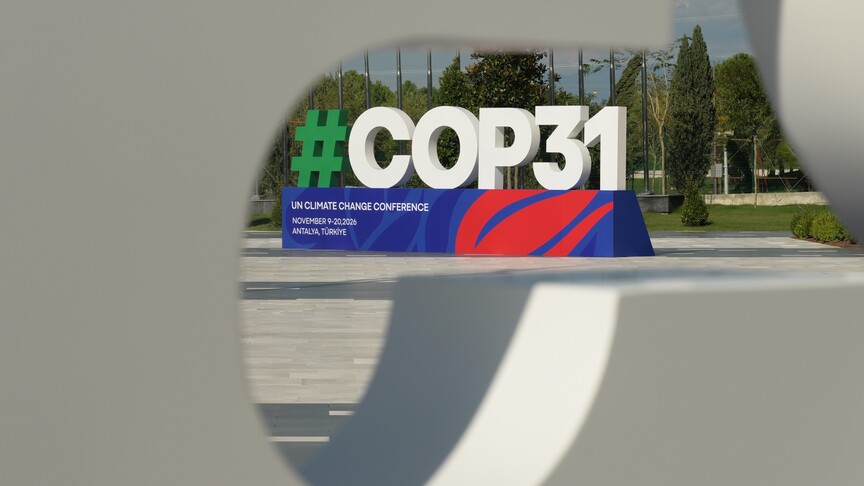
Following a year of devastating floods, deadly heat waves and prolonged droughts, governments will gather in Türkiye’s Mediterranean city Antalya next week for the UN's annual climate conference.
Known as COP31, the Nov. 9–20 conference will bring together world leaders, negotiators, climate experts, scientists, business leaders and civil society representatives to discuss how to cut emissions, fund the transition to clean energy and protect communities from worsening climate impacts.
Türkiye will host the conference and hold its presidency, with Environment, Urbanization and Climate Change Minister Murat Kurum nominated as COP31 president.
Australian Climate Change and Energy Minister Chris Bowen will lead negotiations.
A World Leaders’ Summit is scheduled for Nov. 11–12.
According to Kurum, 91 heads of state and government have confirmed their attendance, with representatives from 196 countries and nearly 300 ministers expected.
Turkish President Recep Tayyip Erdogan, Brazilian President Luiz Inacio Lula da Silva and UK Prime Minister Andy Burnham are among the leaders expected to attend.
Here is what you need to know.
The first UN climate COP took place in Berlin in 1995. More than three decades later, governments will meet in Antalya for the 31st Conference of the Parties to the UN Framework Convention on Climate Change.
The annual meetings provide a forum for negotiating emissions cuts, adaptation measures and the financial and technical support needed to deliver them.
Their most consequential outcome was the 2015 Paris Agreement, which committed countries to holding warming well below 2C above pre-industrial levels while pursuing efforts to limit it to 1.5C.
The gap between that ambition and current plans remains considerable.
An Oct. 27 UN Climate Change assessment found that current pledges are expected to reduce global greenhouse gas emissions by around 6% by 2035 compared with 2019 levels.
Full implementation of all current pledges could increase that reduction to around 9%.
“Collective progress remains clearly insufficient,” UN climate chief Simon Stiell said in the accompanying statement.
The UN Environment Programme’s 2026 Emissions Gap Report separately projects warming of around 2.6C this century even if national climate pledges are fully implemented.
Its pathway with the lowest temporary overshoot of 1.5C requires global emissions to fall 18% by 2030 and 45% by 2035 from 2025 levels.
It also relies on increasing carbon dioxide removal to bring warming back to 1.5C by the century’s end.
The Turkish presidency’s Action Agenda covers 10 themes: clean energy transition and electrification; zero waste and methane reduction; climate-resilient cities; green industrialization; youth and education; food security; oceans and seas; dynamic and resilient health systems; Rio synergies; and the Climate Implementation Bridge.
Finance, technology and capacity building support work across all themes.
The agenda runs alongside formal negotiations, seeking to mobilize voluntary partnerships, investment and practical solutions.
Proposed 2035 targets include increasing electricity’s share of global final energy consumption to 35%, reducing energy use intensity in buildings by at least 25%, and raising the global circular material use rate to at least 15%.
The waste target seeks to halve the projected increase in annual municipal solid waste generation by 2035.
Other priorities include universal climate education, resilient agriculture, stronger health systems and marine ecosystem protection.
The Rio synergies theme seeks closer cooperation on climate change, biodiversity and land degradation, while the Climate Implementation Bridge aims to help countries develop projects ready to attract financing.
Negotiators face disputes over who should finance climate action, how to move away from fossil fuels and how to turn national pledges into projects on the ground.
Developing countries need funding both to cut emissions and to prepare for worsening climate impacts.
UN Environment Programme's (UNEP) 2026 Adaptation Gap Report, released Nov. 4, puts their adaptation needs at around $305 billion annually by 2035.
International public adaptation finance from developed countries reached just $28.2 billion - $31.7 billion in 2024, money needed for measures such as flood defenses, reliable water supplies and early warning systems.
Even delivering COP30’s call to triple adaptation finance by 2035 would cover only 20%–29% of estimated needs after adjusting for inflation, UNEP said.
“The world is not ready to adapt to current climactic conditions, never mind what overshoot of 1.5°C will bring,” UNEP Executive Director Inger Andersen warned.
On fossil fuels, countries still lack a collectively agreed transition roadmap. Brazil presented its own proposals on Nov. 3, but these are voluntary presidency contributions, rather than negotiated commitments binding countries to a common plan.
Previous UN climate summits have established emissions targets, financing commitments and mechanisms to support vulnerable countries, although implementation still remains uneven.
The Kyoto Protocol, adopted at COP3 in Japan in 1997, set binding emissions reduction targets for industrialized economies. However, the US never ratified the treaty.
The Paris Agreement, adopted at COP21 in 2015, brought developed and developing countries into a shared framework to hold warming well below 2C while pursuing efforts to limit it to 1.5C. Countries agreed to submit successive national climate plans every five years.
Financial support gained further prominence at COP27 in Egypt in 2022, where countries agreed to establish a loss and damage fund for developing nations particularly vulnerable to climate impacts.
COP28 in Dubai in 2023 called for “transitioning away from fossil fuels in energy systems,” alongside tripling global renewable energy capacity by 2030.
COP29 in Baku in 2024, countries set a goal of mobilizing at least $300 billion annually for developing countries by 2035, with developed countries taking the lead. Developing nations criticized the amount as insufficient.
COP30 in Belem, Brazil, in 2025 adopted 59 adaptation indicators and called for at least tripling adaptation finance by 2035. However, countries failed to agree on a fossil fuel transition roadmap, leaving a key issue unresolved ahead of Antalya.
news_share_descriptionsubscription_contact

contact_the_ombudsman
is_there_an_error_in_this_story