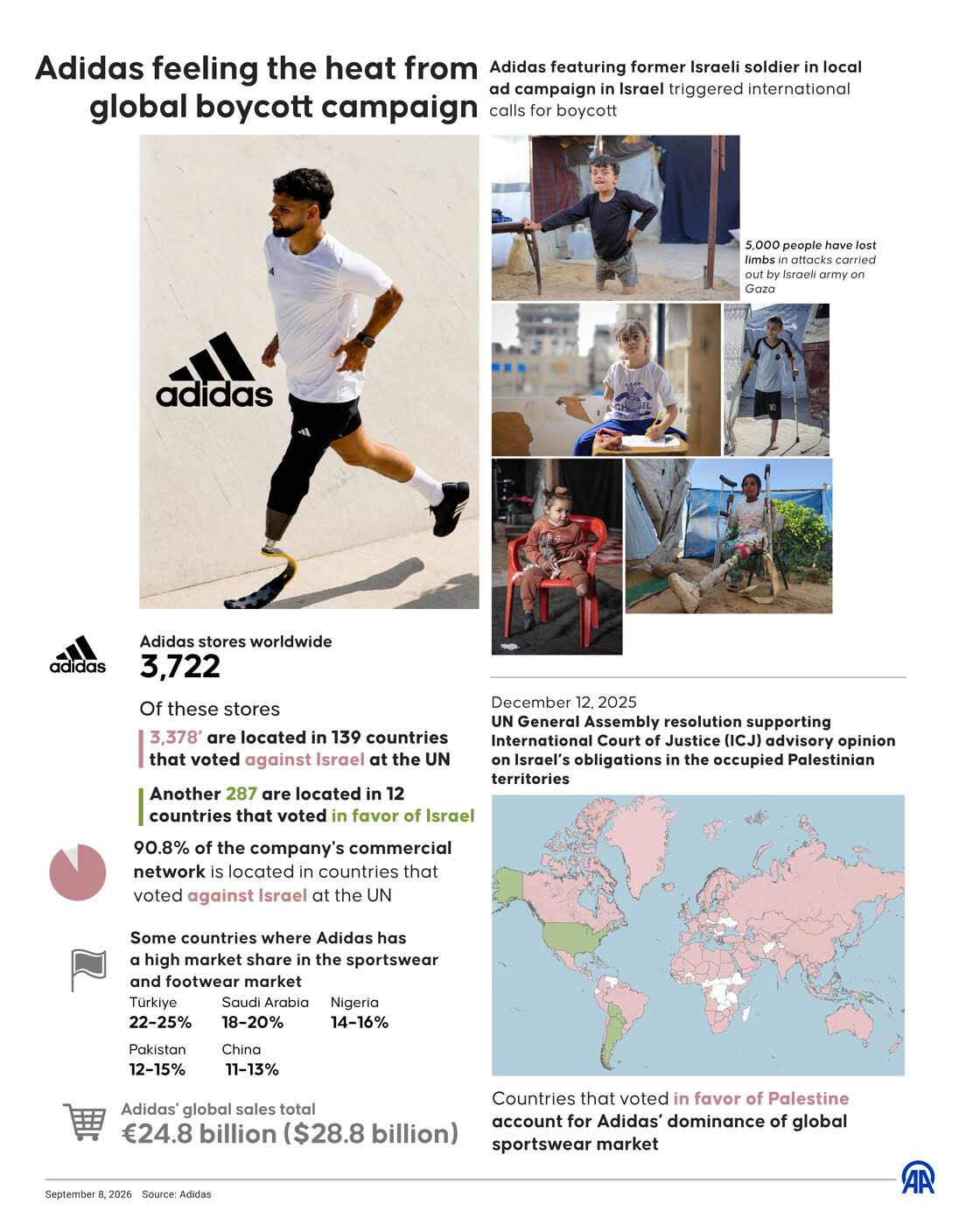

German sportswear manufacturer Adidas is facing mounting boycott calls after selecting a former Israeli soldier who participated in attacks on the Gaza Strip and lost a leg while serving in the Israeli army to promote its “single-shoe service.”
The selection of retired Israeli soldier Shalev Biton as the face of the campaign has intensified criticism of Adidas, raising questions about the company’s global image and operations in major markets.
Following the backlash, Adidas said the campaign was developed by its local team in Israel and was not part of the company’s global advertising strategy.
Adidas Arabia issued an apology, saying it was aware of the concerns caused by the campaign and was taking regional sensitivities seriously.
International boycott calls have continued to grow because of the use of the retired Israeli soldier to promote a service for amputees at a time when a large number of civilians in Gaza have lost limbs.
The controversy has brought Adidas’ extensive commercial presence in countries supporting Palestine into focus.
Adidas’ official website lists 3,722 sales locations worldwide.
When the locations are compared with the results of a historic UN General Assembly resolution adopted Dec. 12, 2025, supporting the International Court of Justice’s advisory opinion on Israel’s obligations in the occupied Palestinian territory, a striking picture emerges.
The resolution was adopted with 139 countries voting in favor, 12 against and 19 abstaining.
A comparison of the UN vote with Adidas’ official store data shows that 3,378 locations are situated in countries that supported the resolution, corresponding to 90.8% of the company’s global physical network.
The 12 countries that voted against the resolution have a combined 287 Adidas locations. Most are concentrated in the US, with 179 locations, Israel with 62, and Argentina with 41.
According to its 2025 financial report, Adidas’ global net sales rose 5% from the previous year to €24.81 billion ($28.8 billion), while operating profit surged 54% to €2.06 billion.
Countries that supported the UN resolution also include markets underpinning Adidas’ position in the global sportswear industry and driving its growth.
Türkiye, one of the strategic markets in Eastern Europe and its broader emerging-market network, has 125 sales locations, according to Adidas’ official store locator.
With an estimated 22% to 25% share of Türkiye’s sportswear and footwear market, Adidas ranks among the sector’s two largest players. Alongside 40 locations in Istanbul and 10 in Ankara, its extensive wholesale network makes Türkiye a market with high potential exposure to the commercial effects of a boycott.
China, which accounted for 15% of Adidas’ global revenue in 2025, is another particularly sensitive market.
The company’s latest first-half results showed that currency-neutral sales in China grew by a record 16%. Adidas’ share of the Chinese sportswear market is estimated at around 11% to 13%.
As previous consumer boycotts in China have cost global brands billions of euros, the country is considered one of the most critical potential risk areas for Adidas.
Saudi Arabia, the Middle East’s largest economy, has 101 official Adidas sales locations and serves as one of the company’s main regional revenue markets.
Adidas is estimated to hold an 18% to 20% share of the country’s rapidly expanding sportswear market. Consumer sensitivities across the Gulf are seen as a major financial factor behind Adidas Arabia’s swift apology.
Adidas is also among the leading brands in Pakistan’s premium sportswear segment, with an estimated market share of 12% to 15%. Its strong recognition among young urban consumers makes Pakistan one of the markets where social reactions can quickly translate into commercial consequences.
In Iraq, Adidas operates through distributors and wholesale channels, and holds an estimated 10% share of the branded sportswear market.
Nigeria, Africa’s largest economy and most populous country, is central to Adidas’ long-term growth strategy on the continent. The company, which operates through wholesalers and local retail partners, has an estimated market share of 14% to 16%.
Adidas’ latest first-half results demonstrate the importance of emerging markets where boycott calls are being made.
The company recorded 14% currency-neutral growth in global net sales during the first six months of 2026, marking one of the strongest periods in its history.
Wholesale operations accounted for 60% of revenue, while direct-to-consumer sales generated the remaining 40%. Currency-neutral sales increased 27% in Latin America and 11% in emerging markets.
Although physical store numbers do not directly correspond to sales volumes, Adidas’ large market shares and extensive presence in Türkiye, China, Saudi Arabia, Pakistan, Iraq and Nigeria indicate that the controversy may not remain a local issue and could potentially create a global revenue risk amounting to billions of euros.
With the number of company-operated concept and outlet stores standing at 2,022, protecting global brand perception and consumer confidence remains of critical importance to Adidas.