BEIJING
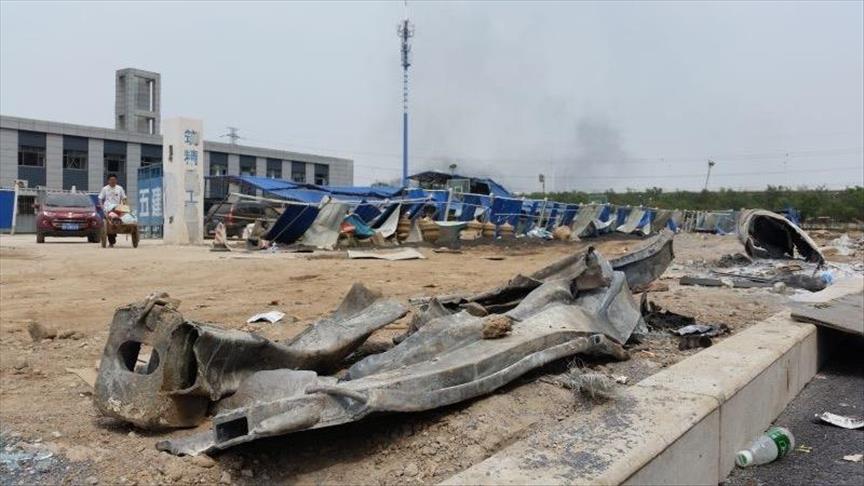
Teams of experts and soldiers continued identifying and transferring Thursday the chemicals stored at a warehouse hit by a fatal blast in the northern Chinese port city of Tianjin last week.
Wen Wurui, Tianjin Bureau of Environmental Protection chief, said that the explosions that first struck the warehouse in the Binhai New Area had affected the environment to a “certain extent.”
He assured, however, that data collected from the air and water indicated there would not be a significant impact on human health, state news agency Xinhua reported.
Saying that the teams could not work during rainfall and nighttime due to safety reasons, he said, “there is a great variety of chemicals and the placement is very complicated.”
“We can't say when the cleanup work in the blast center will be finished," he added.
While the majority of the sodium cyanide -- highly toxic upon contact with water -- that had spilled on the ground has reportedly been cleared, some of the substance still remains in containers.
The presence of potassium nitrate, sodium nitrate, calcium carbide and ammonium nitrate have also been confirmed.
Meanwhile, Tianjin’s mayor, Huang Xingguo, has claimed responsibility over the accident that has left 114 people dead and 64 missing.
"As the principal leader of Tianjin, I have inescapable responsibility for the incident," Huang told reporters Wednesday as he spoke with media for the first time since the initial blasts.
Huang said the chemical plants in the Binhai New Area would be relocated to the Nangang Industrial Zone located around 25 kilometers (15.5 miles) away.
Xinhua reported Wednesday that although Chinese regulations forces “dangerous” warehouses to be at least 1,000 meters away from transport hubs and public buildings "the [Tianjin] warehouse was only 560 meters away from the Vanke residential community and 630 meters from a rail station.”
Some of the executives of Tianjin Rui Hai International Logistics Co. -- the owners of the warehouse -- are under police detention and were interviewed about "false ownership”.
China's Cabinet of ministers, the State Council, has set up a panel to investigate the accident and to "define the nature and gravity of the accident, and determine liability", according to a statement.
The investigators will also advise what punishments should be given when charges are laid.
Mayor Huang also assured local businesses -- 176 of which have been affected -- that "the difficulties will be temporary and risks can be solved."
Around 17,000 households have also been affected by the blasts, with some asking for compensation.
Zong Guoying, the Binhai New Area’s top official, said Thursday that the government has estabilshed a work center to resolve issues related to the crisis.
"The degree of impact varies from apartment to apartment," Xinhua reported him as saying. "If it needs to be torn down, we will tear it down. If we should build new apartments to locate the residents, we will relocate them. We will compensate according to law."
Meanwhile, the UN’s special rapporteur on human rights and toxic waste has warned China about its lack of transparency, criticizing how "[the] chemical disaster serves as yet another tragic example of the need of information about hazardous substances to protect, respect and realize human rights."
Calling the alleged lack of information “truly tragic" Baskut Tuncak said in a statement Wednesday: "The reported restrictions on public access to health and safety information and freedom of the press in the aftermath are deeply disturbing, particularly to the extent it risks increasing the number of victims of this disaster."
Chinese President Xi Jinping has urged authorities to learn from the "extremely profound" lesson.
On Tuesday, Yang Dongliang, the secretary of the State Administration of Work Safety who served as vice mayor of Tianjin until May 2012, was accused of a "breach of discipline” by his previous employers.
The investigators will also advise what punishments should be given when charges are laid.
Since the blast, China’s most populated city Shanghai has launched widespread work-safety inspections for enterprises dealing with hazardous chemicals, inflammable materials and explosives.
The military has also ordered the army and armed police to conduct thorough examinations of their weapon, ammunition, fuel, chemical, explosive and toxic material warehouses, according to the People's Liberation Army’s newspaper.
A circular said that priority should be placed on safely storing inflammable, explosive and biochemical hazardous materials, as well as ammunition disposal.
*Anadolu Agency correspondent Fatih Erel contributed to this story from Geneva.