Anadolu Ajansı © 2026


WASHINGTON
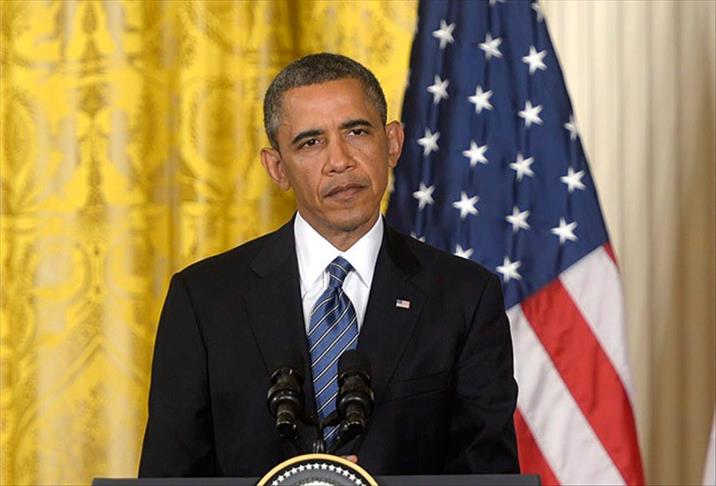
U.S. President Barack Obama on his annual April 24 statement is expected to use the expression "Meds Yeghern” meaning “Great Catastrophe” in the Armenian language to characterize the incidents of 1915.
April 24 is the date to mark the anniversary of the tragic incidents by the Armenian diaspora. Turkey and Armenia will once again watch attentively what term the U.S. President Obama will use in his annual 24th April statement to commemorate the 1915 event.
During his 2008 Presidential election campaign, Obama used the word “genocide” to characterize the incidents that caused heavy casualties for both Armenians and Turks. While conducting his presidential campaign, Obama also promised the Armenian diaspora that he would recognize the “genocide” if he was elected president. Despite his comments before taking office, Obama avoided using the 'g-word' in his annual April 24 statements while at the White House although he says his personal opinion has not changed on what occurred in 1915. Obama is expected to take the same line this year regarding the incidents.
“I have consistently stated my own view of what occurred in 1915, and my view has not changed. A full, frank, and just acknowledgement of the facts is in all of our interests. Nations grow stronger by acknowledging and reckoning with painful elements of the past, thereby building a foundation for a more just and tolerant future. We appreciate this lesson in the United States, as we strive to reconcile some of the darkest moments in our own history. We recognize those courageous Armenians and Turks who have already taken this path, and encourage more to do so, with the backing of their governments, and mine,” Obama cited in his statement last year.
Historically, despite Armenian diaspora's pressure on U.S. presidents to recognise 1915 incidents as genocide, no president apart from former president Ronald Reagan has used the term, causing pressure to be born on the U.S. Congress by Armenians.
Congress members from California and New Jersey, which have high numbers of Armenian-Americans, show sensitivity to the incidents because of voter concerns. Chairman of the Senate Foreign Relations Committee Democrat Robert Menendez, Democrat Congressmen Adam Schiff of California and Frank Pallone of New Jersey are leading figures at Congress who pay attention to the incidents.
With the influence of the Armenian diaspora, every year resolutions on the 1915 incidents are submitted to foreign relations committees of both the Senate and the House of Representatives.
Recently, a draft resolution related to the issue passed the Senate's committee. However, due to the Easter holiday, the resolution will not be handled earlier than April 24 on the Senate floor. Although the resolution will stay on the list for debate until the end of the Congress' legislative year, the possibility of coming to the floor is quite low as it will no longer be 'meaningful' anymore.
There are no signs that Harry Reid, the Democrat Majority Leader in the U.S. Senate, who is responsible for bringing the resolutions to the floor, will highlight the resolution on the agenda.
A similar draft resolution passed the Foreign Relations Committee in the House of Representatives in 2010 but was not brought to the floor despite heavy pressure from the Turkish embassy in Washington and the Turkish community. The resolution was not brought to the Congress in the following three years, especially after the Arab awakening, when Turkish-Armenian relations entered their 'golden age' and the Republicans, who did not lean to Armenian resolutions, became dominant in the House of Representatives in the 2010 by-elections.
A recent resolution emerged by the Armenian lobby after last year's Gezi Park incidents and Istanbul-based 17 December operations. As the resolution is not expected to come to the floor at the Senate and President Obama is likely to avoid using the 'g-word', the Armenian diaspora is now focusing on the centennial anniversary of the incidents.
Even though the Armenian diaspora started piling on pressure and began intense lobbying, attention does not appear to be focused on 2014's resolution. In 2015 which sees the hundredth anniversary of the incidents, it is expected that the diaspora will try to convince Obama to use “genocide” in next year's April 24 statement, and to focus on Congress to pass a resolution on the 1915 incidents.
The critical question is whether Obama will keep his promise on recognizing the incidents as a “genocide” in his last two years of presidency. On the other hand, the Armenian diaspora is likely to continue to shape U.S. public opinion and congress members through its activities.
If the U.S. recognizes the 1915 incidents as “genocide”, one of the impacts on the cases in the U.S. courts will be the Armenians' rights to compensation from Turkey. As present, many cases in the U.S. have been dismissed as they are not consistent with U.S. federal foreign policy and are not constitutional if the U.S. does not recognize the incidents as "genocide." Therefore, to move forward on these compensation cases, it is necessary for the U.S. government to recognise the Armenian genocide.
Turkey, being a member of NATO, is an important ally of the U.S. and is a key partner in the Middle East. Consistent with U.S. policy to date, the U.S. does not want to lose a partner like Turkey when dealing with the civil war in Syria, Iran’s nuclear policy and Ukraine. The Incirlik base in the south of Turkey is also a critical asset for the U.S. for regional operations. Apart from having strong and long-standing defense cooperation between the U.S. and Turkey, economic ties have visibly increased in recent years. As a result of this, the U.S. is likely not to risk all aspects of its relationship with Turkey for the sake of debatable past between Turkey and Armenia.
englishnews@aa.com.tr
news_share_descriptionsubscription_contact