NEW DELHI (AA) - The lower house of the Indian parliament has passed a landmark food security legislation touted by the Congress Party-led government as a game-changer and dismissed by the opposition as a mere vote-buying scheme, inviting bouquets and brickbats.
"The National Food Security Bill is a small step in the right direction," Biraj Patnaik, principal advisor to the Supreme Court's food commissioner (tasked with monitoring implementation of government food schemes), told the Anadolu Agency on Tuesday.
"It may not have all that we may have wanted, but it is now a starting point for future struggles," he said.
The bill, which still must be passed by the upper house to become law, seeks to ensure food and nutritional security by providing specific entitlements to certain groups.
The Congress-led government's flagship scheme will legally entitle 67 percent of India's population to subsidized grains under the Targeted Public Distribution System (TPDS).
Beneficiaries will be entitled to 5 kgs of rice, wheat or coarse cereals for Rs. 3, Rs. 2 and Rs. 1 per kg a month, respectively.
The bill categorizes the population into the poorest of the poor group, a priority group and excludes 25 percent of the rural and 50 percent of the urban population.
The poorest of the poor will receive 35 kg of food grain per family per month, while those in the priority group will receive 5 kg of food grain per person per month.
The bill specifies that the federal government will provide states with funds in case of short supplies of food grains, while also providing assistance for meeting transport expenses and the costs of handling food grains and margins paid to shop dealers.
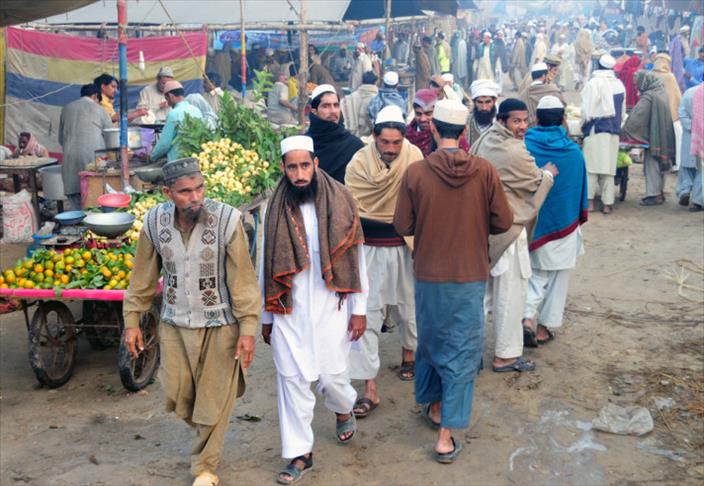
"Food takes up most of my earnings," Naseem, a vegetable vendor, told the AA. "If I get food at this rate, I will have some money left for other needs."
- Skeptical
Rinku, who makes a living washing and dry-cleaning clothes, said the government shops that were supposed to sell food at subsidized rates never seemed to have anything in stock.
Chetan Bhowmick, a financial analyst, said a previous version of the food security bill -- aimed at reducing malnutrition -- had been launched amid much fanfare in 1975.
"The scheme was called the Integrated Child Development Scheme (ICDS)," Bhowmick said. "It has been around for the past 38 years, and now again another bill to remove malnutrition?"
"Any additional requirement of funds under the ICDS scheme can be met through supplementary demands for grants and savings," he added. "I think the Food Security Bill means 'another bill for the poor and dollars for the Congress'."
According to the Confederation of Indian Industries (CII), the massive outlay of funds required for rolling out the food security program is bound to raise the fiscal deficit by putting an additional burden of billions of rupees on the exchequer.
"Such a large outlay at this point in time would definitely have a negative impact on the fiscal deficit," CII President Kris Gopalakrishnan said in a statement.
"This needs to be managed," he added.
One day after the bill was passed, the rupee hit a new low, with the Bombay stock exchange's Sensex index diving by over 500 points.
"As far as the issue of additional burden is concerned, it would add Rs. 25,000 crore [multiplied by ten million] annually to the food subsidy," Rana Kapoor, president of the Associated Chambers of Commerce and Industry, said in a statement.
He added, however, that with proper implementation, the long-term benefits in terms of human capital would far outweigh the costs.