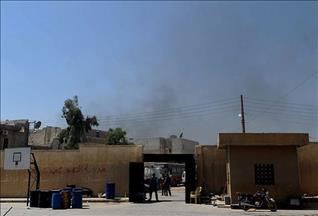
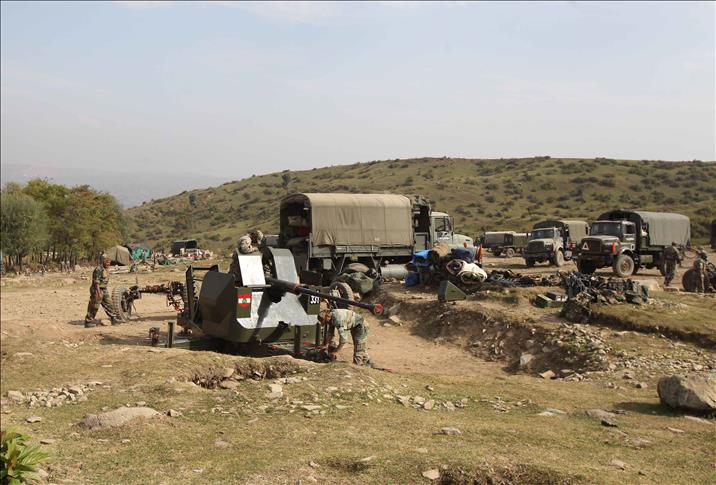
Every summer, Ghulam Mohideen Sheikh finds himself in the middle of a war zone. Mortar explosions announce the mornings, and his modest house wobbles with every blast. For half a century now, the people of Sitaharan, Mohideen’s idyllic village, and almost 20 adjoining villages in the Indian held Kashmir have dreaded summers. Summer, the villagers say, means war, a war that has killed dozens of people.
“When a hand grenade blasts, one becomes deaf for a few seconds,” says Mohideen. “Imagine when an 80 pound shell blasts half a mile away, and then another one goes off and then another and so goes the day! That is our life.”
Spread at the foothills of Himalayas, the villages lie just below one of Kashmir’s largest meadows, Tosa Maidan, which the Indian Army uses as a firing range for its heavy artillery. In April 2014, the lease for using the 3000-acre meadow as a firing range comes to an end, and the Army has already sought an extension of the lease. But this time the villagers have come together to form a group, Tosa Maidan bachao front (Save Tosa Maidan Front), which has approached the State Government and specially the Chief Minister of Kashmir to not renew the lease and at the same time are gathering public support across Kashmir.
“We are coming together for the first time against all the odds of our voicelessness, of the Army’s harassment and of the big money involved, to fight for our right to live a normal life,” says Adil Jehangir, the village head of Sitaharan.
The Ministry of Tourism, on their website, define Tosa Maidan as not only a famous pasture but also a significant location for its historical background.
“It is said that Tosa Maidan is one of those pastures which the shepherds of other neighboring countries also used to visit in ancient times. It is said that the Mughal rulers had constructed a seven-storied building – Dam-Dam – here,” the Tourism ministry says. “During the summer, the camps of the Gujjar community and shepherds with theirgrazing sheep in the pastures present a riveting picture. Also, the fragrance of wild flowers refreshes the whole environment,” it adds.
They do not, however, mention that a vast area of the meadow is littered with live unexploded shells that go off from time to time, mutilating and killing the villagers who go to graze their cattle.
Chief Minister of Jammu and Kashmir, Omar Abdullah, accepted in the State Assembly that people had been killed due to unexploded shells in Tosa Maidan.
“Since 1965 till date, 63 persons have lost their lives and 41 received injuries due to unexploded shells in Tosa Maidan,” Omar had said.
He also stated that none of the victims or their families had ever received compensation from the Army or from that Jammu and Kashmir Government.
The villagers claim that the actual number of dead is more than double the official figures. Of the 63 counted dead, one was a 14-year-old boy, a class IX student named Shabeer Ahmad, who had stepped on an unexploded shell in Tosa Maidan.
“He went with to the meadow to graze the sheep and didn’t return till afternoon. Then a young girl came with his identity card and said that Shabir was lying in a pool of blood,” says Abdul Qayoom, his father. “He was a mess; his body was so perforated that we could not even give him a final bath.”
The Police and Army refused to give Qayoom any compensation for his son’s death saying that his son should not have been in the firing range at all.
“But we all have livestock here, and that is our primary source of income,” he says. “All our cattle for decades have been grazing there. How can we stop going there”?
Other than living on livestock, the villagers are mostly laborers and grow corn, which they say doesn’t fetch enough to live a poor life.
“Poverty keeps us from moving from this village and where will we go. The whole villages will have to go to other places then,” says Mohideen, who is one of the village leaders and strongly involved in the campaing for saving the meadow. Mohideen knows too well what a blast does because he too had a close shave.
“I was a young boy then and had gone to picnic to the meadows. In the grass I saw a small colorful metal thing and just picked it, like kids do,” he says. “And it blasted, leaving for shocked.” Mohideen’s finger tips were smoking and dripping molten flesh and fire, and like him, there are hundreds in this village, who for years thought it was a normal thing to happen. “But this time, we are trying our best to save our village and our people and this meadow.”
This time, the Forest department- under whose jurisdiction the meadow comes- too has spoken against the use of the forestland as a firing range. “Last time when the lease was extended (in 2004) for 10 years, it was illegally done by the Home Department without any intimation to the Forest Department,” reads a letter that the Forest Department has sent to the Government. “It is illegal besides objectionable under the provisions of existing Forest (Conservation) Act, Central legislations and directives of the Hon’ble Supreme Court of India,” the letter says.
National Human Rights Commission of India has also taken cognizance of a complaint against the extension of Tosa Maidan lease to Army, seeking a detailed report on the matter from Ministry of Defence.
The Army is maintaining silence on the issue and refusing to comment while quietly pushing for the extension of lease. “The Chief Minister conveyed a proposal to set up a high-level committee under the State Chief Secretary including Army and State Government representatives to re-examine the short term extension of the range while also considering alternate locations,” a handout issued to the Press by Army’s Northern Command last month said.
The villagers of Sitaharan know that the game they have stepped into is too big and complicated. They also know that the summer will come again but they hope for a quieter summer this year, knowing somewhere in their hearts that it is a long time before the war in their village ends.
by Zahid Rafiq
news_share_descriptionsubscription_contact

contact_the_ombudsman
is_there_an_error_in_this_story