By Deepak Adhikari
BHAKTAPUR, Nepal
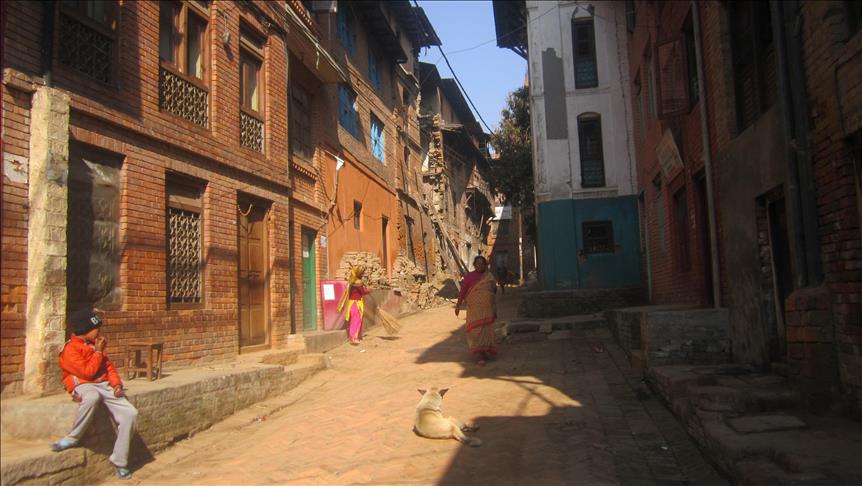
Standing on the rickety wooden stairs of her modest four-story mud-and-brick home in a narrow street of Bhaktapur, a small city in the Khatmandu Valley, Ashmaya Suwal recalled the day her life fell apart.
On the morning of April 25 of last year, she had gone to fetch water from a nearby communal tap when the ground beneath her feet shook from a powerful 7.8-magnitude earthquake.
"There was nothing I could hold on to. I fell down. Everyone panicked. Some of us wept," she said.
It was only the beginning of her woes, which in the nine months since the disaster have only become worse.
When she returned home, the 75-year-old -- who had been living alone since her husband’s death 18 years earlier -- found the half-century-old structure riddled with cracks.
Fearing for her life, and long abandoned by her middle-aged sons, Suwal joined some 150 other earthquake survivors in makeshift tents set up in the courtyard of a local school building.
The small open space has since become a refuge for many elderly people, like Suwal, and their families who were rendered homeless by the quake.
Most tents bear the logos of the U.S. Agency for International Development (USAID) or the Chinese government.
Inside the tents, there are a few articles of clothes, thin mattresses on the floor and a handful of vegetables -- but little else.
Outside, a cluster of traditional homes are still supported by wooden pillars -- frail protection against nature’s fury.
Asked about the biting cold that plagues the tent-dwellers on wintry nights, Suwal responded forlornly.
"I have no alternative. Why would I spend nights in a tent if I have a home only a few meters away?" she asked.
"Sometimes, dew seeps through the holes [of the tent], soaking my bed. My legs are swollen from the cold," she lamented.
A few days ago, Suwal saw a doctor who simply told her to stay warm.
"Maybe I should go back to my house. It’s riddled with cracks, but maybe it’s better," she said.
A similar story is told by her neighbors, who had lived in crammed, run-down homes before the quake rendered them uninhabitable.
Toothless and wheezing, Mangal Lal Kasula, 88, touches the wall of what used be his four-story home.
Suffering from asthma, Kasula has trouble speaking, communicating through hand gestures and whispers interpreted by his 22-year-old granddaughter, Sushila.
A widower, Kasula was alone on the third floor of his home when the earthquake struck last April, bringing down the front wall.
Another powerful quake, which rocked Nepal the next month, ended up reducing his home to rubble.
"The cold makes me shiver throughout the night; I want to rebuild my home as soon as possible," he told Anadolu Agency.
He currently resides in a tent set up inside the courtyard of Shree Padma High School, one of several camps that provide shelter to earthquake survivors.
Led by Rabin Raya, an army of volunteers supervises the camps, over which a banner flutters bearing the name of Indrayani Sarokar Samaj, a local charity.
Raya, who works as a chef at the Kathmandu Guest House in the tourist district of Thamel, said his group had raised some 400,000 Nepali rupees (roughly $3,700) for the reconstruction of the quake-damaged Indrayani Temple.
"Local people rendered homeless by the quake needed our support after charity groups started leaving," Raya told Anadolu Agency.
For a month after the earthquake, the volunteers provided food for hundreds of desperate quake victims. But for some reason, the tents at the camps were eventually removed.
The Salvation Army, a London-headquartered Christian charity that operates in 127 countries, came to the rescue.
Salvation Army volunteers arrived with new tents, cleaning equipment, and basic foodstuffs for 80 families, Raya said.
The local authorities, by contrast, were slow to deliver aid and appeared unsympathetic to the survivors.
So far, quake victims have received assistance worth some 25,000 Nepali rupees, including a recent 10,000-rupee donation for warm clothes.
Meanwhile, earthquake-affected residents are still waiting for a 200,000-rupee grant and a 300,000-rupee loan at a subsidized interest rate, along with models for earthquake-resistant homes.
Frustrated by the delays, many have begun rebuilding on their own.
Government bickering
It took eight months for Nepal’s bickering political parties to approve a reconstruction bill proposed in parliament.
Last month, the government appointed civil engineer Sushil Gyewali as CEO of Nepal’s National Reconstruction Authority.
Gyewali told Nepal’s Republica newspaper that reconstruction work would begin in another three months to coincide with the quake’s first anniversary.
Gyewali’s office is now preparing to deploy about 3,000 personnel, including 100 engineers and 100 local representatives, to the 14 districts hardest-hit by the quakes, the newspaper reported.
"Without identification of the actual victims, the relief amounts [disbursed] for house reconstruction may only create other problems," Republica quoted Gyewali as saying this week.
"So the [reconstruction] authority needs to carry out detailed damage assessments and identify genuine victims," he added. "And this may take around three months."