
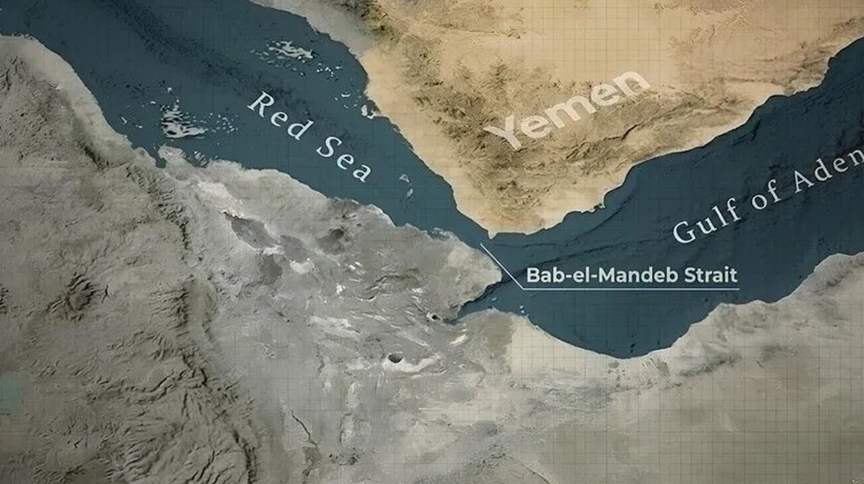
Bab el-Mandeb is no longer an isolated theater of the Yemeni conflict; it has become an operational extension of the broader US–Iranian confrontation, with pressure in the Red Sea compounding the effects of disrupted navigation through the Strait of Hormuz. The Houthis need not close the strait to generate strategic consequences: increasing perceived risk is sufficient to divert vessels and raise insurance premiums. In September 2026, transit volumes remained approximately 47% below pre-crisis levels. Although the conventional balance of military resources clearly favors Saudi Arabia and its allies, this advantage has not translated into a sustainable political outcome because of divisions among anti-Houthi forces and the Houthis' capacity to absorb strikes. Protracted attrition is therefore the most likely near-term trajectory, while durable stability will require both a countervailing Yemeni institutional center of gravity and a regional security framework involving the Red Sea littoral states.
Since late 2023, the Yemeni conflict has moved from the margins of international attention to the center of the global maritime security agenda. The US Maritime Administration documented more than 100 separate attacks on commercial vessels between November 2023 and October 2025, affecting ships linked to more than 60 countries. As the confrontation between Washington and Tehran widened in 2026, the strait became a node in an interconnected network of maritime chokepoints linking Hormuz and Suez, rather than merely a commercial passage under threat. Bab el-Mandeb cannot be secured as long as Yemen is treated as a discrete maritime theater. At the core of the impasse is the inability of all parties to convert military capabilities into lasting political gains.
Tehran views Yemen as one component of a wider network of arenas through which it can impose pressure on its adversaries beyond Iranian territory while preserving a substantial degree of plausible deniability. Washington, for its part, regards Houthi escalation as an Iranian instrument for dispersing US naval and air assets. Nevertheless, reducing every Houthi action to a direct Iranian decision overlooks the movement’s own domestic calculations, particularly those concerning organizational survival and its bargaining position within Yemen.
The 2026 regional war deepened this interconnection. As navigation through Hormuz was disrupted, Saudi Arabia became more dependent on Red Sea exports from Yanbu. In July 2026, the Houthis announced restrictions on vessels linked to Saudi ports, thereby targeting the same alternative route. Oil flows through Bab el-Mandeb reached 8.1 million barrels per day in the second quarter of 2026—a figure that reflects the rerouting of shipments away from Hormuz more than an improvement in security.
Geographically, the strait is approximately 29 kilometers (18 miles) wide, although its effective navigation channels are considerably narrower. Mayyun Island, also known as Perim Island, lies near its center, while the surrounding islands and coastlines provide strategic vantage points that may be used for military purposes. This geography enables a resource-constrained actor to generate effects disproportionate to its conventional military capabilities: merely increasing perceived risk may be sufficient to divert vessels around the Cape of Good Hope. The UN Conference on Trade and Development (UNCTAD) estimated that disruptions in the Red Sea increased global maritime transport distances by 17% in 2024. In September 2026, the strait recorded 1,215 transits, approximately 47% below pre-crisis levels. It is therefore necessary to distinguish between controlling the strait and possessing the capacity to threaten navigation through it. The Houthis do not control both shores, but they can make passage commercially costly and operationally unattractive.
The relevant actors do not view the strait through the same lens. For the Houthis, it is an instrument of deterrence and recognition; for Iran, an extension of its influence across two chokepoints; for Saudi Arabia, a defensive line protecting the western coast and development projects; and for the United States and its allies, part of the global commons. China has opted for pragmatic arrangements, establishing direct contacts with the Houthis to secure the passage of its tankers. Egypt faces declining Suez Canal revenues without being a direct party to the fighting, while Israel views the strait through the prism of the security of its trade and southern ports.
| Actor | Potential Gain | Cost or Risk |
| Houthis | Enhanced leverage in regional calculations and domestic mobilization | Retaliatory strikes and economic isolation |
| Islamic Republic of Iran | Expanded deterrence without direct confrontation on Iranian territory | Wider war and damage to relations with trading partners |
| Kingdom of Saudi Arabia | Mobilization of support to protect alternative export routes | Threats to exports and facilities, and higher defense costs |
| Egypt | Stronger incentives for maritime security cooperation | Declining Suez Canal revenues |
| United States | Leadership of a coalition to protect freedom of navigation | Resource depletion and the burden of multiple fronts |
| Import-dependent economies | No direct gain | Higher transport, energy, and food costs |
Source: Author's assessment based on UNCTAD data and Reuters reports.
Accordingly, the primary short-term beneficiaries are those actors capable of converting a maritime threat into political leverage at a tolerable cost, while the regional and global economy bears the broader burden, with poorer populations shouldering the largest share.
Saudi military expenditures reached approximately $83.2 billion in 2025, compared with $7.4 billion for Iran—a ratio of roughly 11 to 1. This disparity, however, has not determined the political or military outcome. The anti-Houthi coalition possesses air superiority and international legitimacy, but divisions among its principal field components, including the Southern Transitional Council and the Joint Forces, have impeded unified command and durable territorial gains. The Houthis, by contrast, benefit from centralized leadership, a demonstrated capacity to absorb strikes, and the ability to assemble drones and missiles locally with support from the Islamic Republic of Iran.
Even the government offensive against coastal areas near the strait in October 2026 was accompanied by conflicting accounts regarding control of certain positions and islands. The central lesson is that control of territory does not automatically secure the sea, and that a temporary decline in attacks does not mean the capacity to resume them has been eliminated.
The trajectory of the crisis depends on the interaction of four variables connected to developments in Bab el-Mandeb: the direction of the US–Iranian confrontation; the Houthis’ capacity to sustain the threat; the ability of the Yemeni government and its allies to consolidate coastal control; and the parties' willingness to negotiate over maritime security. Their interaction produces four principal scenarios that vary in likelihood and in their security and economic consequences.
A comparison of the four scenarios suggests that continued attrition is driven not only by the parties’ capacity to sustain military operations but also by their persistent inability to translate coercive power into a stable political settlement. A tactical truce could provide the Houthis with time to rebuild their arsenal and consolidate their gains. The institutional scenario, by contrast, proceeds from a different premise: maritime security ultimately depends on establishing a viable political and security alternative on the ground, rather than relying primarily on air power.
Disruption to navigation through Bab el-Mandeb reflects a deeper political and institutional imbalance within Yemen and across its regional environment. Military strikes may temporarily reduce the frequency of attacks, but they neither eliminate the Houthis' sources of power nor prevent the movement from exploiting the strait during renewed cycles of escalation between Tehran and Washington. Sustainable maritime security therefore requires measures that address both the immediate threat to navigation and the political conditions that enable it. Four policy priorities follow from this analysis:
The decisive question in the next phase will not be who possesses the capacity to threaten Bab el-Mandeb, but who can translate geographic leverage into a stable security arrangement without drawing the region into a wider war.
*Opinions expressed in this article are the author's own and do not necessarily reflect the editorial policy of Anadolu.
This piece first appeared in the November 2026 edition of Anadolu Agency's monthly publication, AA Briefing.
news_share_descriptionsubscription_contact

contact_the_ombudsman
is_there_an_error_in_this_story