By Kaamil Ahmed
DHAKA, Bangladesh
The familiar labels of western clothing brands still poke out from among the rubble of the Rana Plaza disaster.
A modest concrete hammer and sickle worker’s memorial is now all that marks the unguarded site outside Bangladesh’s capital Dhaka where, two years ago on Friday, a factory complex collapsed, killing 1,135 people.
At least 100 people were still missing after the three-week long rescue operation. Rumors are widespread about human remains being found at the site by local children and people who scavenge scrap metal from its foundations.
A boy keenly confirms this by drawing attention to a pond beside the rubble. Plunging his hand into the murky water, he produces a blackened human bone.
Few deny Bangladesh’s garment sector has moved on in the two years since the disaster, which put a spotlight on the industry’s unsafe buildings, violations of workers' rights, government neglect and the responsibility of western brands.
The brands, many of which sourced from factories in the building, had promised compensation for the families of killed workers and for the rehabilitation costs for the 2,500 survivors.
The compensation pot is still however a full $6 million below the $30 million mark, which was considered a minimum. It only reached that mark after a last-minute flow of contributions ahead of the second anniversary, including a $1 million input from Italian brand Benetton.
Half of the total compensation has been provided by the Ireland-based Primark, which had a heavy presence in the factories. Some brands have contributed nothing.
The efforts at rehabilitation of workers have received praise from many quarters for the relief they have offered the survivors. But they have also been fractured, with various NGOs, authorities and western brands operating separate schemes.
This has frustrated many of the survivors, who are upset about receiving unequal compensation and feel they have not been consulted about their needs.
Nilufa Begum, 35, spent nine hours trapped inside the building before she was saved. Despite being transferred from hospital to hospital, she has had no surgery or physiotherapy and her foot is still bent out of shape. She has to rely on crutches, which prevents her from returning to work in the factories.
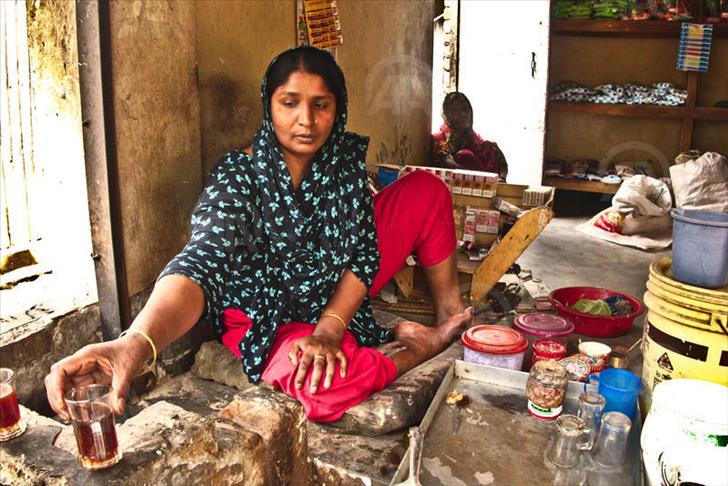
Begum was trained by an NGO, the Center for Services and Information on Disability, in running a business. She was also given goods to start a small shop. She claims, however, that it has only caused her more stress.
Begum produces a green booklet, a record of her debt. She says that she has had to take loans to buy extra goods because much of the 35,000 taka ($450) worth of goods she was provided with had either expired or garnered no demand in her community.
Begum also says that the 10-month training she was given meant she was not eligible for more compensation. She adds that paying off her debt, which requires daily payments, has prevented her from saving for further medical treatment.
“It’s been two years now, people used to come and check how I was doing but not anymore. I have to do something. My life cannot go on like this,” Begum says.
The struggle to meet daily needs is one faced by more than half of Rana Plaza survivors, according to a survey released Wednesday by poverty prevention charity ActionAid Bangladesh. Almost two-thirds still suffer from depression and trauma.
Feli, also 35, was also given support to start a shop as part of her rehabilitation but complains it has made her life more complicated.
“They gave us the shop and 35,000 taka worth of goods and that’s it,” she says. “Is this 35,000 taka securing our future?”
Feli says that her family has not been able to pay the rent for the shop or their home for the past five months; they cannot return to their village as her husband had to sell his land.
“We’re stuck in Dhaka and I can’t work, I can’t do anything,” she says.
While the disparate rehabilitation programs mean survivors have varying experiences and complaints, the feeling that they have been exploited is common, according to labor rights lawyer Chaumtoli Huq.
Huq says many of the programs implemented by brands and NGOs presented serious shortcomings, especially those that ask survivors to start businesses.
“You need two to three years to start up a business. You can’t just give capital to start up a shop,” says Huq. “Is it just for show or for genuine rehabilitation?”
She says she is particularly concerned by micro-finance schemes, which essentially put survivors in debt despite many of them still being traumatized.
“I was in court with a Tazreen fire survivor and she said to me: ‘it feels like people are doing business on our bodies,’” says Huq, referring to a factory fire that killed more than 100 people only months before the Rana Plaza collapse.
“You can’t expect the charity of businessmen to improve labor rights,” says Huq.
Labor representation
Had the workers in Rana Plaza had a union, they might have been able to prevent the disaster. This refrain is common among labor rights activists in Bangladesh.
On April 23, the day before the Rana Plaza building folded, it was evacuated after a large crack was discovered in one of the floors.
“The engineer said the factory cannot continue in that building,” says Feli, a Rana Plaza survivor. “But we were forced to come back because they made it a payday. And of course, we needed the money.”
She says the workers had been in the building only half an hour on April 24 when it collapsed.
Activists insist that better representation would have meant workers could have resisted demands to return to work in the building.
“Rana Plaza wouldn’t have happened with a union representing the workers,” says labor lawyer Huq, adding that the workers are the best-placed people to monitor workplace rights. “You’re not going to get better eyes and ears than the people in the factories.”
The importance of improving factory safety was immediately recognized after the Rana Plaza incident with a monitoring system set up and split between the government, the mainly-European brand backed Accord on Fire and Building Safety, and the U.S.-backed Alliance for Bangladesh Worker Safety.
Though the factory inspection system has not been without its share of controversies, most factories have now been evaluated, leading to more than 50 being closed down.
The same progress has not been made with regards to worker representation, despite amendments made to the labor law, under international pressure, in July 2013.
Srinivasa Reddy, the Bangladesh director for the International Labor Organization, says that while 290 new unions have been registered since the Rana Plaza disaster, “this still only represents less than 5 percent of the garment workers.”
Labor rights activists complain that the law still requires a union to have 30 percent of the workforce sign up before it can be registered. This is made difficult by the large workforces and alleged intimidation by factory management.
Violence and intimidation against unionizing workers is widespread, according to a report released by Human Rights Watch on Wednesday.
The report mentions verbal abuse of workers, harassment by outside gangs and torture-like beatings in private rooms of factories.
It claims that select firings, in particular, have crippled unions as it has made other workers fear for their jobs. At least 40 recently registered unions are reportedly already defunct because of this.
“When we start organizing for freedom of association, if management finds out about this, they start mental torture,” says Babul Akhter, President of the Bangladesh Garments and Industrial Workers Federation.
He says factory managers pile pressure onto workers by hiking personal production targets or haranguing them over toilet breaks.
“And if management realizes they’re going to apply for registration of the [union] they will terminate their job,” he says. “If that’s not possible because of workers’ unity, then they’ll hire outside musclemen or goons.”
Such intimidation of workers is already illegal under Bangladeshi labor law but, according to Human Rights Watch, the law is weakly implemented and, in some cases, the labor department has been accused of helping factory owners.
Atiqul Islam, President of the Bangladesh Garment Manufacturers and Exporters Association, which represents the factories, refuted the allegation that unionizing workers are targeted, at an event held to commemorate the disaster on Thursday.
Earlier in the week he had told a similar event that the workers' "age and cultural backwardness make trade unions vulnerable to abuse."
Despite the lingering concerns about workers rights and safety in the aftermath of the Rana Plaza disaster, there is also belief that Bangladesh’s garment sector could set new standards that can be followed by others.
“A large number of employers are seeing it as an opportunity for reform (...) in the long run it will bring good for the sector,” says the Internatıonal Labour Organization's Reddy. “A number of other sectors could benefit from reform of practices in the garment sector,” he says.