16 February 2016•Update: 17 February 2016
By CS Thana
BANGKOK
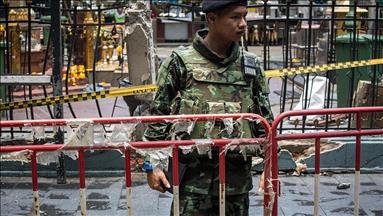
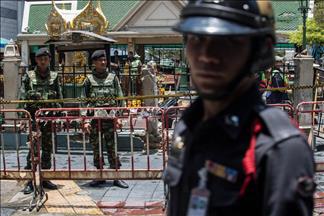
Two Uighur men accused of carrying out a bombing in the Thai capital that killed 20 people last year denied all charges at a military court Tuesday.
The Bangkok court charged Adem Karadag and Yusufu Mieraili with ten counts of criminal violation each, including terrorism and pre-meditated murder – both of which carry the death penalty.
Both suspects maintained their innocence, with Karadag – also identified by Thai police as Bilal Mohammed and as Bilal Turk – insisting that he had entered Thailand after the Aug. 17 bombing, which also left 120 people injured.
His lawyer Choochart Khanphai told reporters outside the courthouse, “my client since his arrest has never confessed to any charge.”
Khanphai attempted to correct his previous statements in the immediate aftermath of Karadag’s arrest in September, which had accorded with those of authorities, who said his client had confessed to the crimes.
"My previous statements were given at a time when I had no access to my client," he said.
Police have said that both suspects have confessed to being paid by a mastermind to build and plant the bomb at a religious shrine in central Bangkok.
The lawyer also underlined Tuesday that he had petitioned the court on Jan. 15 on the ground that his client said he had been tortured by plainclothes men while in military custody.
"My client was intimidated by these men, they were waterboarded, threatened with large dogs and threatened with deportation to China."
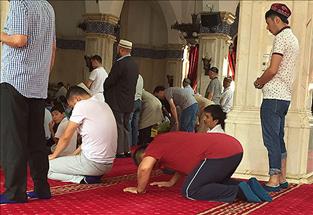
Both Karadag and Mieraili have refused to provide their addresses in China’s northwestern Xinjiang region out of “fear of reprisal" from the government, who the Muslim Turkic minority group accuses of curtailing their cultural and religious rights.
The next court date is set for April 20.
Karadag has said through his lawyer that he is an ethnic-Uighur refugee from Xinjiang Province, and claims to have been naturalized as a Turkish citizen.
While police have claimed the bombings were masterminded by human traffickers, angry at Thai authorities for clamping down on their networks, Khanphai has said that the bomb was connected to the controversial deportation of a Uighur group held in Thai immigration centers to China.
Subsequent TV images of the Uighur sat on a plane blindfolded, handcuffed and under surveillance of guards, provoked uproar among local and foreign rights groups.
The deported Uighur were from a group of around 400 held over immigration offenses in holding centers in Thailand at the beginning of 2014, many of whom claim to have Turkish nationality.
In July, 85 men and 24 women from the group were deported to China, while around 180 were sent to Turkey.
Many Turks welcome Uighur as their own, as they are among a number of Turkic tribes that inhabit a region they call East Turkestan and consider to be part of Central Asia, not China.
In the past year, allegations of torturing suspects to gain confessions have been leveled at both Thai police and military.
Two Myanmar workers have claimed they were physically and mentally tortured until they confessed to the murder of two British tourists on the island of Tao, while Thai NGOs claimed in a report released earlier this month that the use of torture by security forces to obtain confessions in the country's Muslim majority south is “widespread and systematic”.