Max Constant
21 September 2015•Update: 21 September 2015
BANGKOK
More than a year after it overthrew the "populist" government of Yingluck Shinawatra, the Thai junta has launched a new economic strategy aimed at boosting the grassroots economy through public spending.
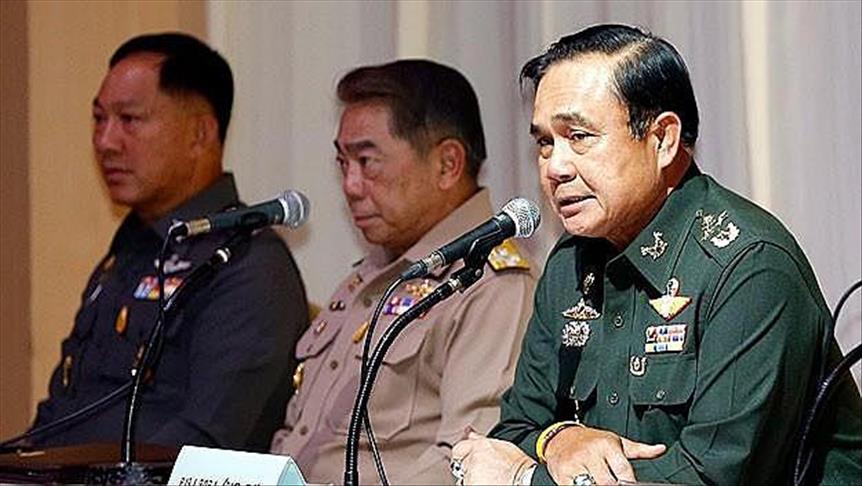
Junta leader-cum-prime minister Gen. Prayuth Chan-ocha, however, was quick to underline that the policy was not the economic “populism” of previous governments led by Shinawatra and her brother Thaksin, local media reported Monday.
“We make a pact together to solve problems and fix past mistakes. This is not populism, it is cooperation between the government and the people,” Chan-ocha stated while announcing a new strategy coined “Pracharat” or “People’s State” at a forum in Bangkok.
Chan-ocha explained that the strategy was aimed at “bringing together people, government institutions, local communities and private enterprises”.
People’s State is based on several stimulus packages totalling tens of billions of dollars aimed at extending soft loans to small and medium-sized enterprises, and credit guarantees to encourage banks to lend to small entrepreneurs.
It will oversee the loaning of one million baht ($28,000) to each of 60,000 villages by two public banks, granting villagers the money to finance sustainable projects, although they will be banned from using the money to pay back their debts.
“If we give money all the time, the problem is that we will have to continue to give more and more and this will become a debt of gratitude,” said Chan-ocha.
“But this government does not want you to owe us a debt of gratitude. Thailand is a people’s state and populism has no place here," he added.
The new policies appear to strongly echo those of Thaksin Shinawatra, the junta’s political nemesis, who was prime minister between 2001 and Sept. 2006 before being unseated in a coup.
During his premiership, Thaksin’s government established one-million-baht village funds for 60,000 villages, which helped finance small economic projects.
He also created low-cost universal health coverage and ordered public banks to suspend farmers’ debts.
After the May 2014 coup, the junta strongly criticized what it called the “populist policies” of the Shinawatra clan.
Last January, the military-appointed National Assembly retroactively impeached Yingluck from her position as prime minister because she failed to stop a loss-ridden rice-subsidies scheme initially aimed at helping the rural poor -- who make up the majority of the Shinawatras' support.
Her political opponents have said the program opened the door for massive corruption, and the military government is currently considering whether to file a civil suit against her to force her to pay back around $14 billion to compensate the country for the scheme's losses.
The move is the latest attempt by the junta to stimulate a declining economy, affected by a drop in exports and huge household debt (85 percent of GDP), which has caused a fall in domestic spending.
Earlier this month, a newly appointed deputy-prime minister in charge of economic matters, Somkid Jatusripitak, launched a 136 billion baht ($3.8 billion) stimulus package to boost growth.
Last month, the National Economic and Social Development board, the state planning agency, reduced its growth predictions for 2015 from 1.5-2.5 percent to 1.5-2 percent because of declining exports.